Comparative Overview of Olive Oil Regulations in Major International Markets
By Carolina Urbano Savelli Gomes
Angel García Pizarro
Cristina Constantí Garriga
September 21, 2026
6 MIN READ
Although olive oil is produced from a single botanical source (Olea europaea L.), its commercial categories are defined by international and national regulations rather than by marketing terminology.
These legally recognized classifications are based on production methods, physicochemical and sensory characteristics, and labeling requirements. Understanding where these regulatory frameworks converge, and where they differ, is essential for international trade compliance.
This review compares the principal regulatory frameworks through five key dimensions: legal classification, physicochemical requirements, sensory assessment, labeling, and enforcement.

The International Olive Council: a shared technical baseline
The International Olive Council (IOC), headquartered in Madrid, establishes the principal international technical standard for olive oils and olive-pomace oils through its Trade Standard Applying to Olive Oils and Olive-Pomace Oils (COI/T.15/NC No 3/Rev.22, June 2026).
While directly applicable only within the framework adopted by its Members, the standard forms the technical basis for numerous national regulations and the Codex Alimentarius. It classifies olive oils according to extraction method (mechanical/physical versus chemical or thermal processing) and physicochemical and sensory criteria:
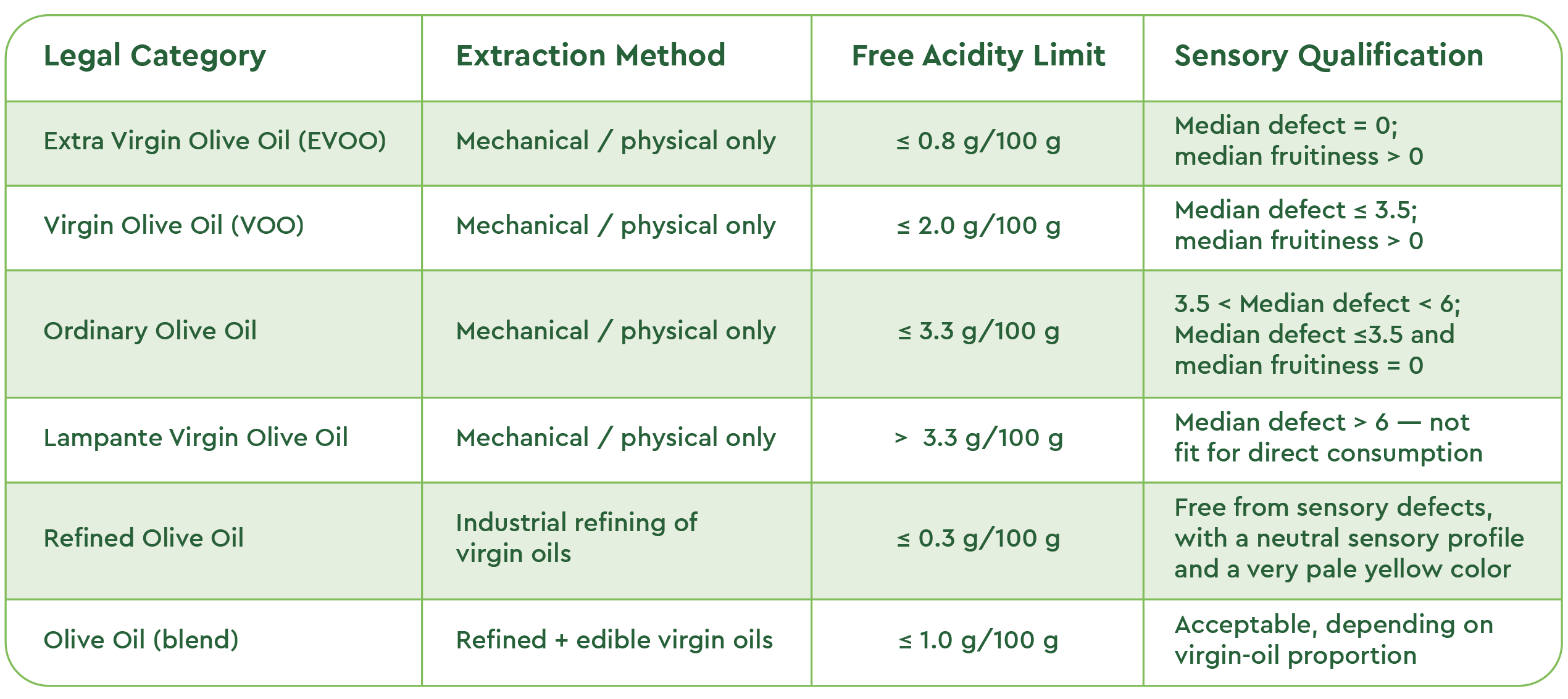
Pomace categories (crude, refined, and olive-pomace oil) are obtained from olive paste residue using organic solvents and cannot be marketed as “olive oil”, regardless of blend ratio.
Commercial classification is determined not only by free acidity but also by compliance with a broader set of IOC and Codex physicochemical specifications, including peroxide value, UV absorbance (K232, K270 and ΔK), sterol composition, wax content, fatty acid profile and ethyl esters, together with mandatory sensory assessment for virgin olive oils.
Codex Alimentarius: the bridge for cross-border trade
Unlike the IOC standard, Codex Alimentarius serves as the internationally recognized reference under the World Trade Organization (WTO) Agreements on the Application of Sanitary and Phytosanitary Measures (SPS) and on Technical Barriers to Trade (TBT). Consequently, it functions as the default international benchmark for countries whose national legislation is absent, incomplete or based directly on Codex provisions.
The European Union: one of the world’s most comprehensive regulatory and traceability frameworks
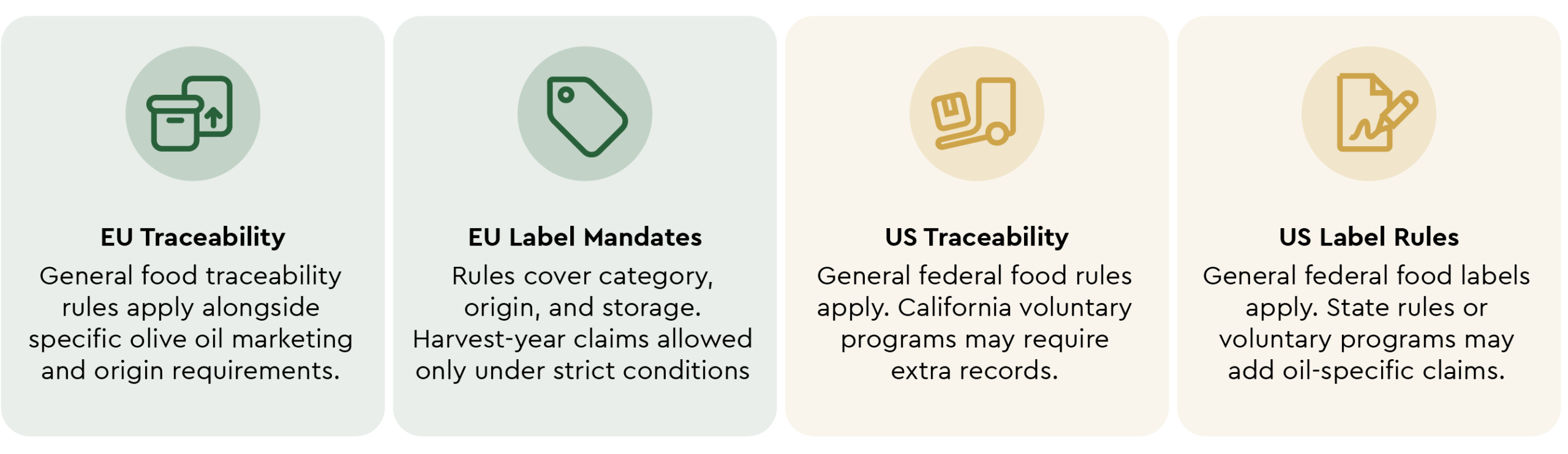
As the world’s largest producer and consumer bloc, the EU restructured its legislation in November 2022 around two pillars:
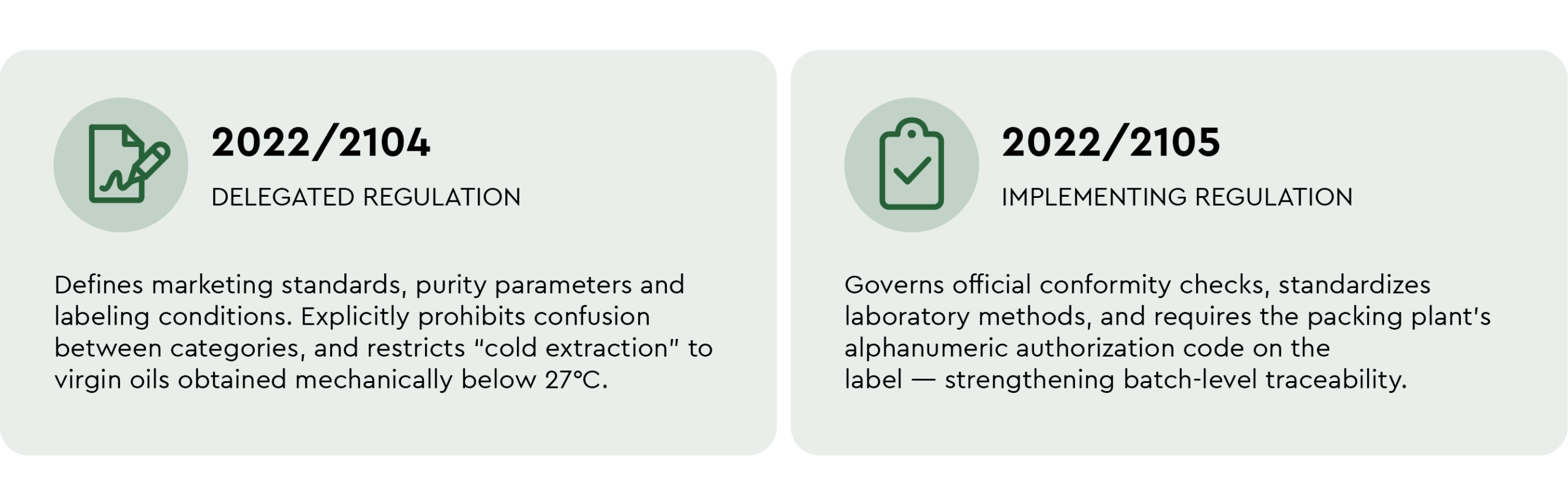
Delegated Regulation (EU) 2022/2104. Defines marketing standards, purity parameters and labeling conditions, and explicitly prohibits confusion between categories. It also restricts terms such as “cold extraction” to virgin olive oils obtained exclusively by mechanical means at temperatures below 27°C.
Implementing Regulation (EU) 2022/2105. Governs official conformity checks, standardizes laboratory methods, and requires the packing plant’s alphanumeric authorization code to appear on the label, strengthening batch-level traceability.

Three labeling rules matter most for B2B formulation and private-label work:
- Harvest year can appear on the label only for EVOO and VOO, and only when 100% of the container’s contents come from a single harvest campaign.
- The QUID rule (Quantitative Ingredient Declaration): if a manufacturer highlights olive oil on the front label of a composite product (such as canned goods, sauces or pastries) Regulation (EU) No 1169/2011 requires disclosure of the exact percentage used.
- A blend of refined and virgin olive oils must be labeled “Olive oil composed exclusively of refined olive oils and virgin olive oils.” The term “virgin” cannot be used as the primary designation for this category.
This principle also applies to blends of virgin olive oils in several producing countries. A recent interpretative circular issued by the Italian Ministry of Agriculture clarified that blends of previously classified extra virgin and virgin olive oils cannot subsequently be marketed as extra virgin olive oil. This approach is consistent with Spanish legislation (Royal Decree 760/2021, Article 8(1)(d)), which prohibits blends of previously classified virgin olive oils from being assigned a category higher than that of the lowest-grade oil in the mixture. Together, these provisions reinforce the principle that the commercial classification of a blend cannot exceed that of its lowest-grade component.
The United States: a hybrid, more voluntary model
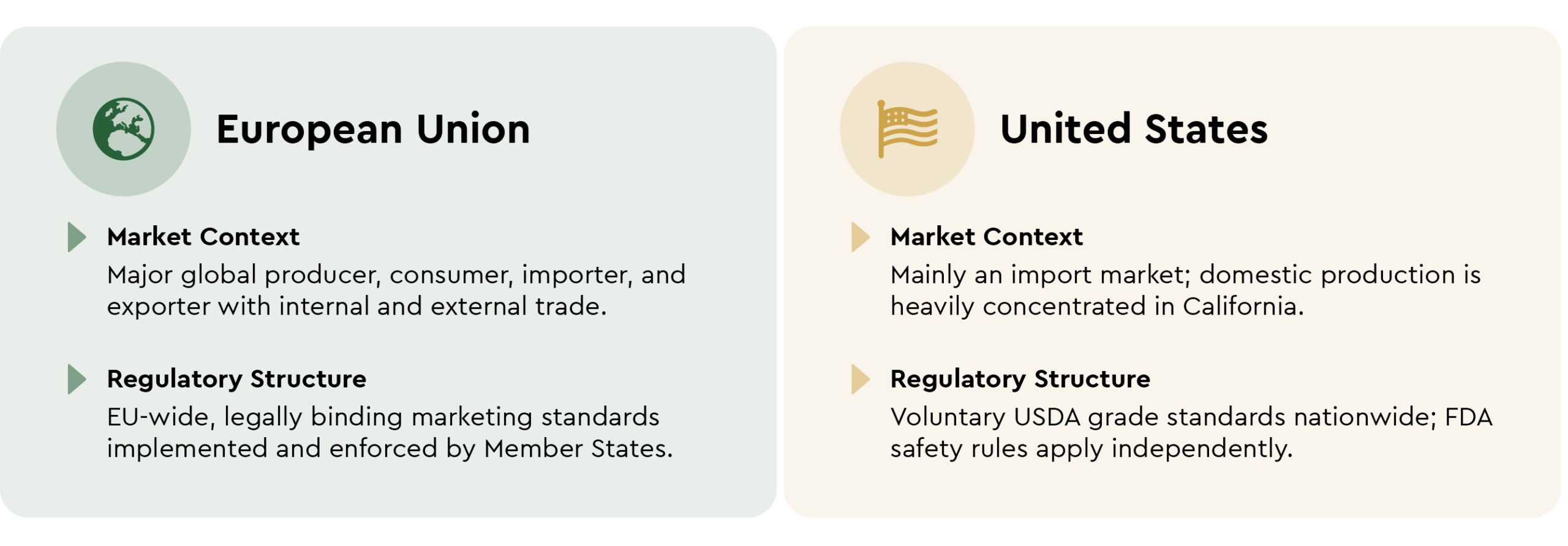
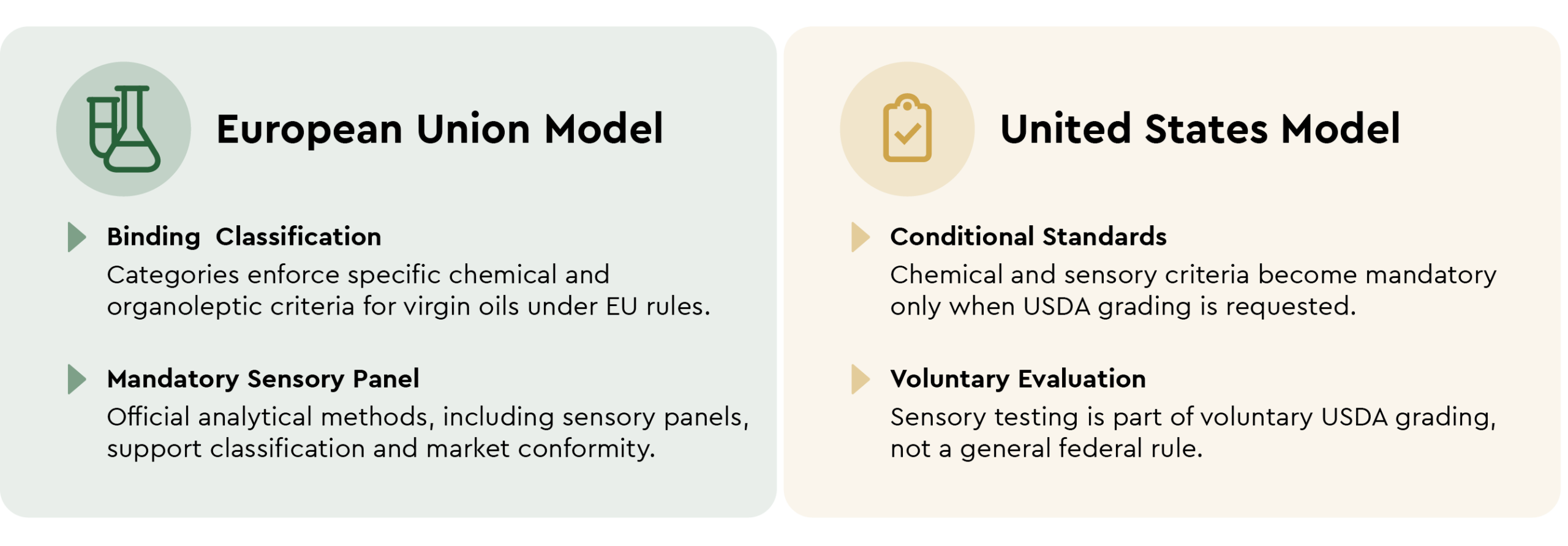
The U.S. approach differs structurally from the European model. Federal legislation separates mandatory food safety and labeling requirements, overseen by the FDA, from the voluntary quality grading system administered by USDA-AMS (U.S. Extra Virgin, U.S. Virgin, U.S. Refined and U.S. Olive Oil), which is broadly aligned with IOC standards.
Unlike the EU, sensory panel evaluation is not a mandatory condition for market entry. California represents a notable exception: under the California Olive Oil Commission (COOC), producers meeting the statutory production threshold are subject to mandatory quality standards and analytical testing requirements that, for certain parameters, are more stringent than the voluntary USDA grades.

Side by Side: Olive Oil Quality Regulation in Europe and in the United States
Why the gaps matter more than the definitions
Although legal definitions are largely harmonized through the shared IOC and Codex framework, regulatory effectiveness ultimately depends on how these standards are implemented through official controls, laboratory verification, and enforcement. A 2020 review in Trends in Food Science & Technology found that, despite the EU’s comparatively strict regulatory system, oils and fats remain among the product categories most frequently reported in official food fraud notifications, highlighting the limitations of current reference methods in detecting sophisticated non-compliance. A 2022 review in Comprehensive Reviews in Food Science and Food Safety reached a similar conclusion, emphasizing that effective market protection requires continuous multi-marker analytical verification rather than periodic compliance checks.
For food buyers, supply-chain directors, and quality assurance teams, managing olive oil product integrity and legal compliance requires shifting from a passive checklist to an active, continuous risk-mapping strategy.
Traditional tick-the-box quality checks often miss the subtle complexities of modern oil processing and global supply networks. Because regulatory enforcement, legal definitions, and customs scrutiny vary significantly across international jurisdictions, procurement teams must thoroughly evaluate market-specific regulatory frameworks.
Misinterpreting how a destination market enforces purity standards or organoleptic parameters introduces severe commercial liabilities, including costly shipment rejections, mandatory re-labeling, and irreparable damage to brand credibility.
To mitigate these risks, industry compliance increasingly relies on a comprehensive dual layer testing protocol:
Official Baseline Methods: Standard regulatory frameworks established by the International Olive Council (IOC) and Codex Alimentarius, such as free fatty acid analysis, peroxide value measurement, UV spectrophotometry, and official sensory panels, remain the required legal benchmarks for commercial grading and trade classification.
Complementary Multi-Marker Profiling: To address sophisticated supply-chain risks – such as subtle blending with deodorized oils or geographic origin inconsistencies – QA teams should evaluate advanced secondary screening as part of a dynamic, risk-based mitigation strategy. Rather than applying a blanket testing protocol, quality managers must assess which specific analytical tool – such as Nuclear Magnetic Resonance (NMR) spectroscopy, Isotope Ratio Mass Spectrometry (IRMS), or targeted trace chemical marker analysis – is best suited to investigate identified risk factors or predictive vulnerabilities.
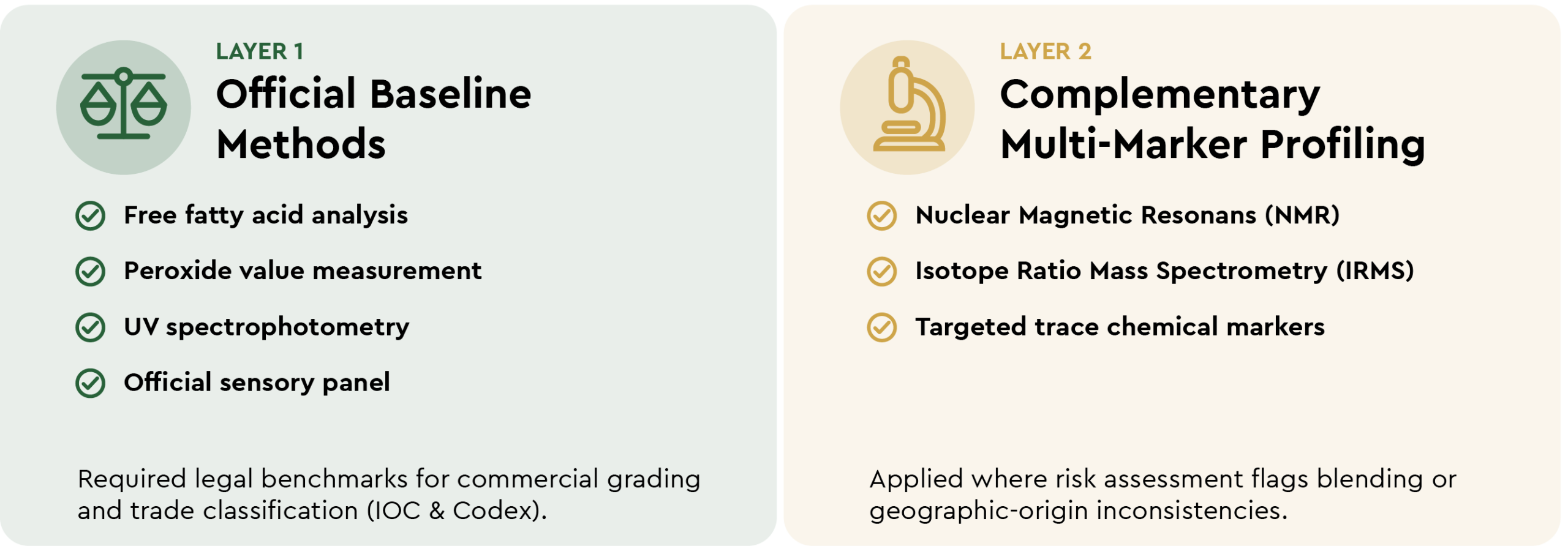
Rather than replacing official IOC and Codex protocols, these targeted multi-marker approaches reinforce standard testing when risk assessments signal a need for deeper verification. Combining mandatory statutory testing with tailored, risk-justified analytics provides buyers with robust cross-border compliance while maintaining analytical efficiency.
About the authors
The Certified Origins Quality team brings together lipid chemists and food-law specialists. The group works on origin-level process audits, advanced traceability technologies, and ongoing physicochemical analysis of edible oils, with the aim of sharing rigorous science that helps B2B buyers verify authenticity across the global olive oil supply chain.



Sources
- International Olive Council (IOC). Trade Standard Applying to Olive Oils and Olive-Pomace Oils, COI/T.15/NC No 3/Rev. 22 (June 2026).
- Codex Alimentarius (FAO/WHO). Standard for Olive Oils and Olive-Pomace Oils, CXS 33-1981.
- European Commission. Delegated Regulation (EU) 2022/2104 and Implementing Regulation (EU) 2022/2105 on marketing standards and conformity checks for olive oil. OJ L 284, 4.11.2022.
- Regulation (EU) No 1169/2011 of the European Parliament and of the Council on the provision of food information to consumers.
- Ministero dell’Agricoltura, della Sovranità Alimentare e delle Foreste (MASAF). Circolare n. 0347821 del 16 luglio 2026 recante disposizioni sulla miscelazione dell’«olio extra vergine di oliva» con l’«olio di oliva vergine». Gazzetta Ufficiale della Repubblica Italiana, Serie Generale No. 169, 23 July 2026
- USDA Agricultural Marketing Service (USDA-AMS). Olive Oil and Olive-Pomace Oil Grades and Standards, United States Department of Agriculture.
- California Olive Oil Commission (COOC).California Olive Oil Commission (COOC). Olive Oil Grade and Labeling Standards (mandatory quality standards applicable to producers subject to the California Olive Oil Commission program).
- Conte, L., Bendini, A., Valli, E., Lucci, P., Moret, S., Maquet, A., Lacoste, F., Brereton, P., García-González, D.L., Moreda, W., & Gallina Toschi, T. (2020). Olive oil quality and authenticity: A review of current EU legislation, standards, relevant methods of analyses, their drawbacks and recommendations for the future. Trends in Food Science & Technology, 105, 483–493. University of Udine / University of Bologna consortium.
- Lozano-Castellón, J. et al. (2022). Extra virgin olive oil: A comprehensive review of efforts to ensure its authenticity, traceability, and safety. Comprehensive Reviews in Food Science and Food Safety, 21(3). University of Barcelona.
Share on


