High Yield Crop Estimates Keep Prices Under Pressure
7 MIN READ
By Franziska Finck — October 28, 2026
Our Monthly Olive Oil Market Report blends real-time data with field insights to
support your private label retail strategy.
Want it monthly?
Sign up here
|
Getting your Trinity Audio player ready...
|
What’s Happening This Month?
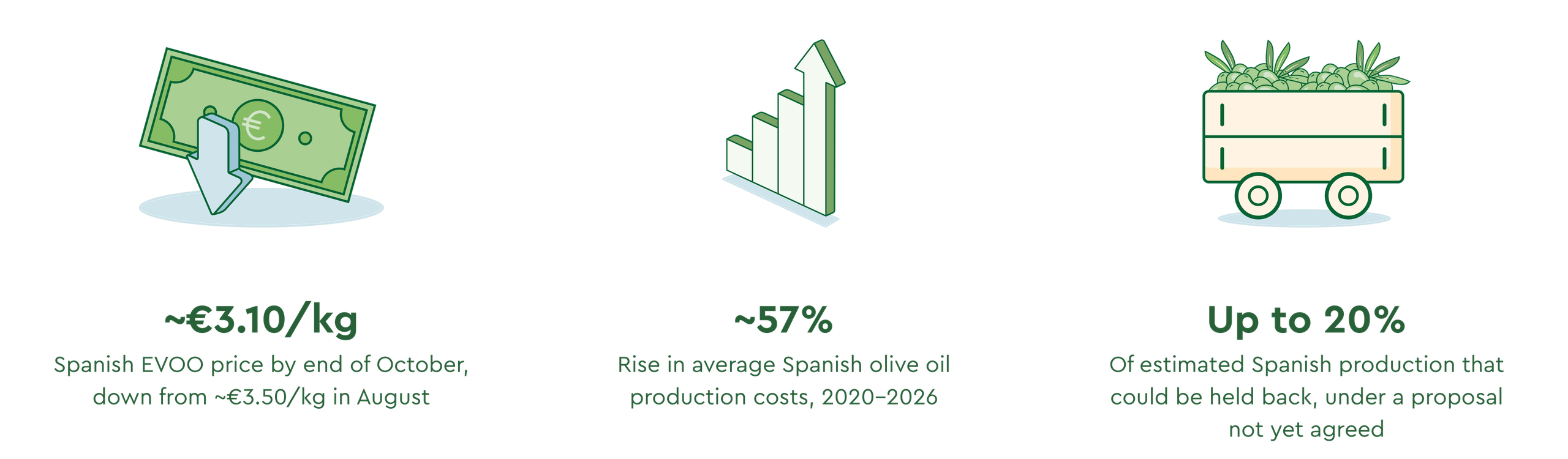
Over recent weeks, olive oil prices have maintained a downward trajectory. According to Poolred, in Spain, extra virgin olive oil prices declined from around €3.50/kg in August and early September to approximately €3.10/kg by the end of October, amid expectations of a good upcoming harvest in the region.
Based on live physical market trading retail-grade conventional olive oil is currently quoted at around €3.70/kg, while organic olive oil stands near €4.50/kg. Italian prices likewise face downward pressure from substantial inventory from the previous harvest and lower pricing in adjacent Mediterranean regions, though the rate of decrease has moderated recently.
The price gap between Italy and Spain has narrowed considerably, from €2.55–3.05/kg in March to €0.85–1.35/kg in October, varying according to specific product profiles and quality tiers. Meanwhile, conventional olive oil trades at approximately €3.50/kg in Tunisia and €3.80/kg in Portugal.
Key figures reported by leading price monitoring platforms include:
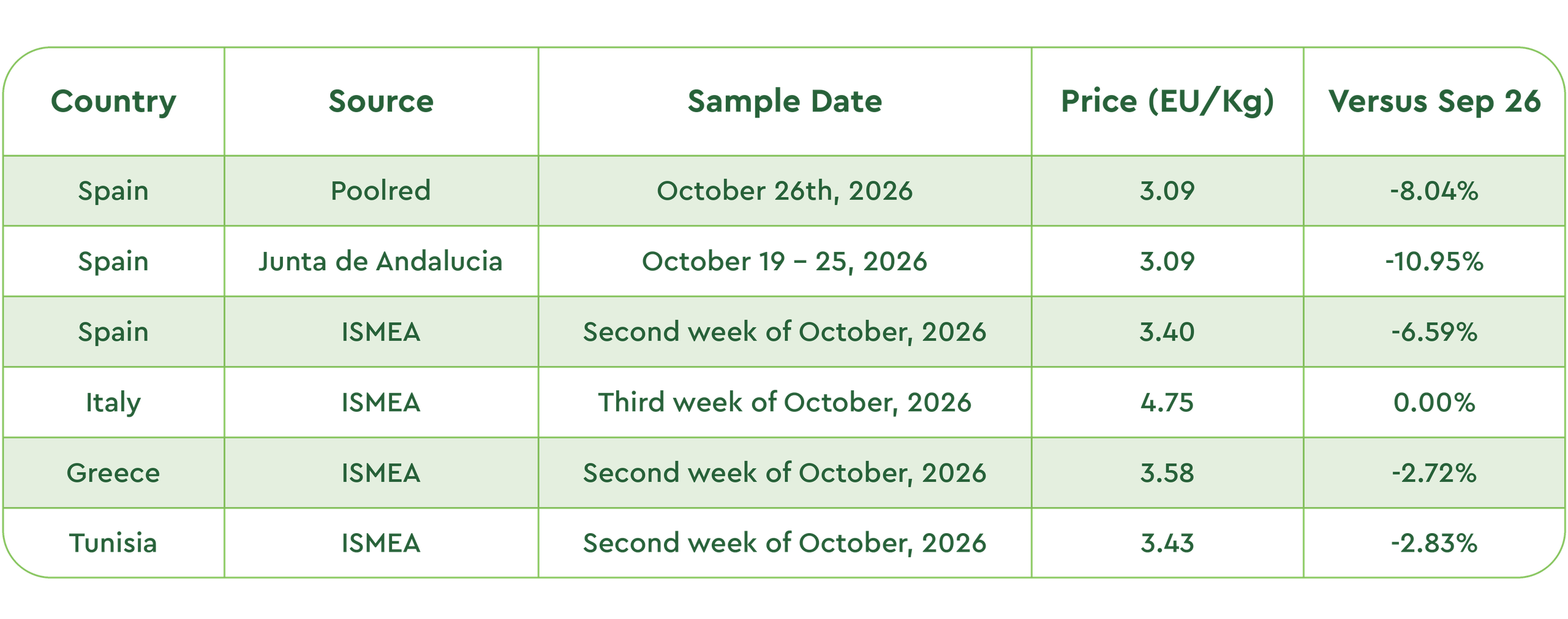
**Note: Reported prices are averages across multiple quality grades. Premium, traceable, clean, pesticide-free extra virgin olive oil typically trades at higher values.
Extra Virgin Olive Oil Price Evolution 2022-2026
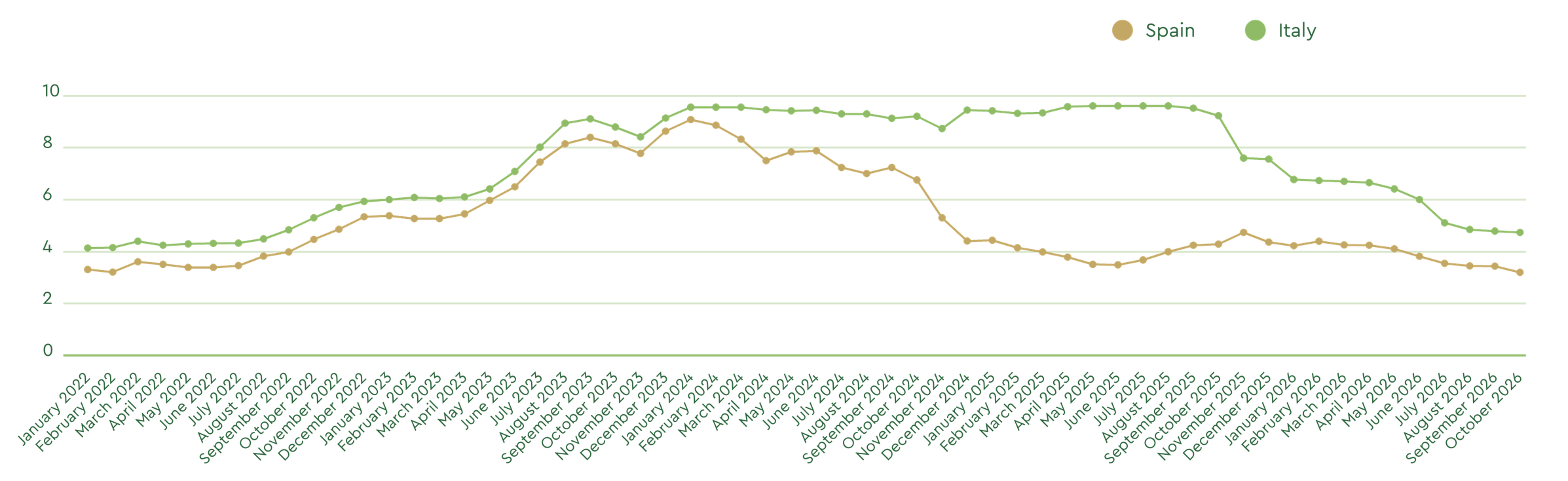
Sources: Poolred, Ismeamercati
Stock Situation in Spain by end of September
As the 2026/27 harvest kicks off, official figures published in September for Spain’s 2025/26 olive oil campaign show total production reached an estimated 1,305,828 tons.

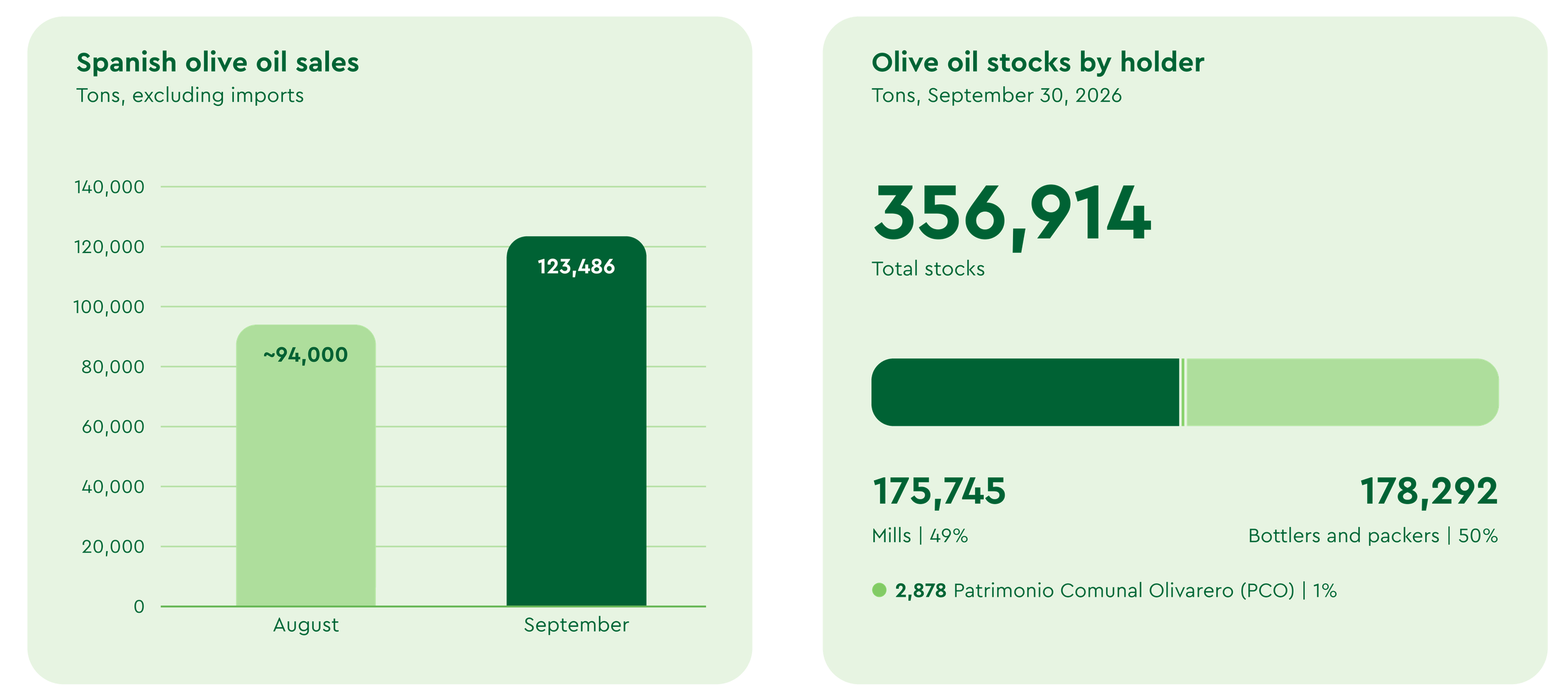
According to official closing data from Spain’s Ministry of Agriculture, Fisheries and Food (MAPA/AICA), Spanish commercial outflows reached 123,486 tons in September 2026 (excluding imports), concluding the 2025/26 marketing year.
Sustained demand reduced Spain’s total physical stocks to 356,914 tons as of September 30, reflecting a net monthly decline of approximately 118,500 tons compared to August.
Spanish olive oil balance data published by the Ministry also shows that cumulative campaign outflows exceeded domestic production by approximately 182,000 tons. This supply deficit required sustained reliance on carry-in stocks from the prior crop cycle and ongoing imports to meet total market demand.
As a result, Spain entered the 2026/27 campaign with an official carry-over of 356,914 tons.
This reserve is distributed across primary holding points: 175,745 tons at production mills, 178,292 tons at packaging facilities and registered commercial operators, and 2,878 tons within the storage network of the Patrimonio Comunal Olivarero.
These volumes represent the working inventory required to maintain regular packing and export commitments until early-harvest milling enters in the core phase and reaches its full industrial scale.
Key Figures of the Olive Oil Market (September) (in Tons)
2026/27 Olive Oil Campaign: Initial Production Estimates
Mercacei, a Spanish trade publication specialising in the olive oil and table olives industry, has published one of the first estimates for the 2026/27 olive oil harvest, covering the main producing countries.
Yield outcomes are expected to vary substantially across regions, driven by weather patterns, ongoing drought conditions, and the natural biennial bearing cycle of olive trees.
Spain is forecast to produce around 1.6 million tons, although extreme summer heat and limited rainfall could affect final yield numbers. Italy’s production is estimated at between 260,000 and 310,000 tons, while Greece is expected to reach 280,000–300,000 tons. Outside the EU, Tunisia’s output could fall to around 300,000 tons, compared with 500,000 tons in the previous season, while Morocco is also anticipating a substantial decline to 120,000–150,000 tons. In contrast, Turkey could produce 380,000–400,000 tons, and Portugal is expecting a strong crop of approximately 200,000–230,000 tons.
If these forecasts materialise, this would represent a percentage increase or decrease in production compared with the 2025/26 harvest as follows:
- Spain: + 23% versus crop 25/26
- Italy: -12 % versus crop 25/26
- Portugal: +14% versus crop 25/26
- Greece: +25% versus crop 25/26
- Tunisia: -40% versus crop 25/26
- Turkey: +34% versus crop 25/26
- Morocco: -18% versus crop 25/26
2026/27 Initial Production Estimates by Country
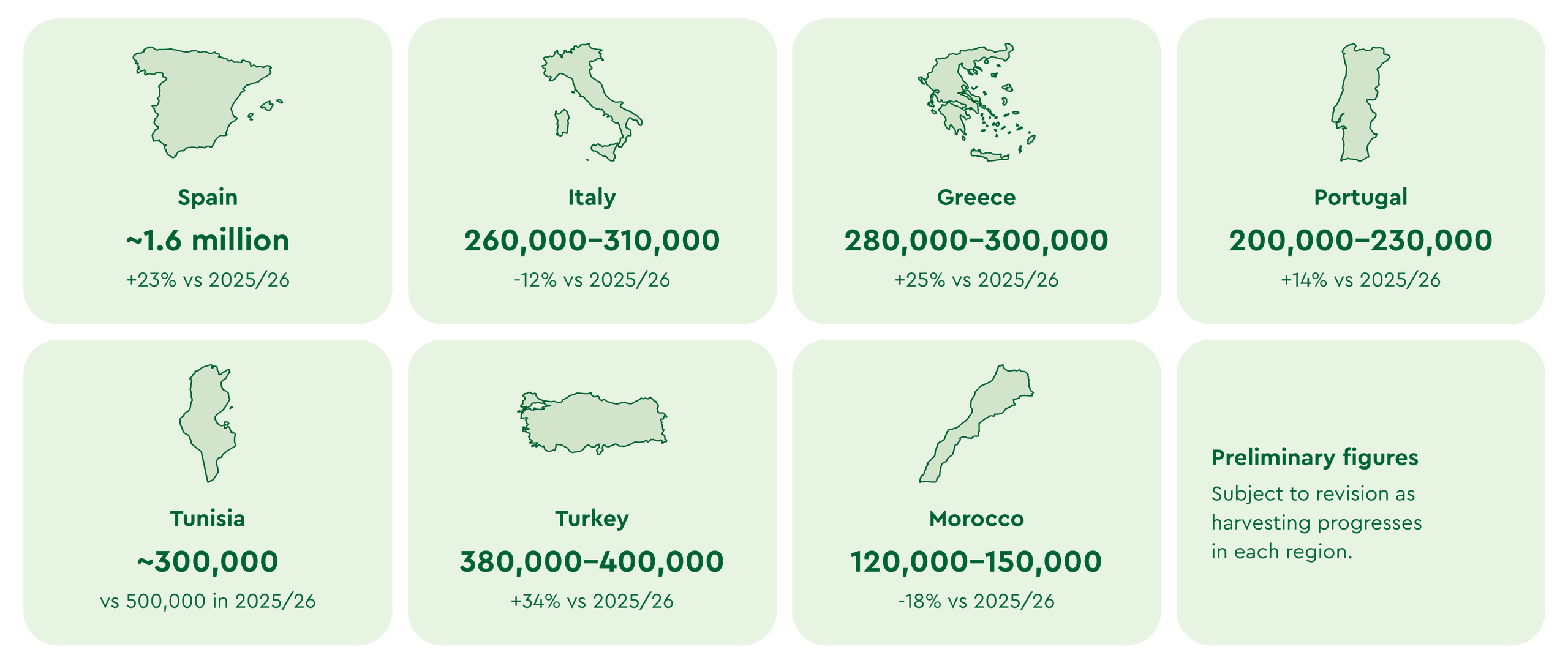
Overall, the initial estimates suggest that global olive oil supply will remain substantial, despite lower production in some countries. Spain’s harvest will be particularly important for market developments, while potentially strong crops in Greece, Turkey and Portugal could increase competitive pressure.
While carryover inventory continues to weigh on valuations and production costs stay elevated, the ultimate harvest yields alongside the dynamics among supply, reserves, and market demand will play a decisive role in shaping price movements over the coming months.
Naturally, all current figures are preliminary and subject to revision as harvest operations proceed in each region.
US Bottled Olive Oil Imports and Taxes: Tunisia Gains Ground as Italian and Spanish Volumes Decline
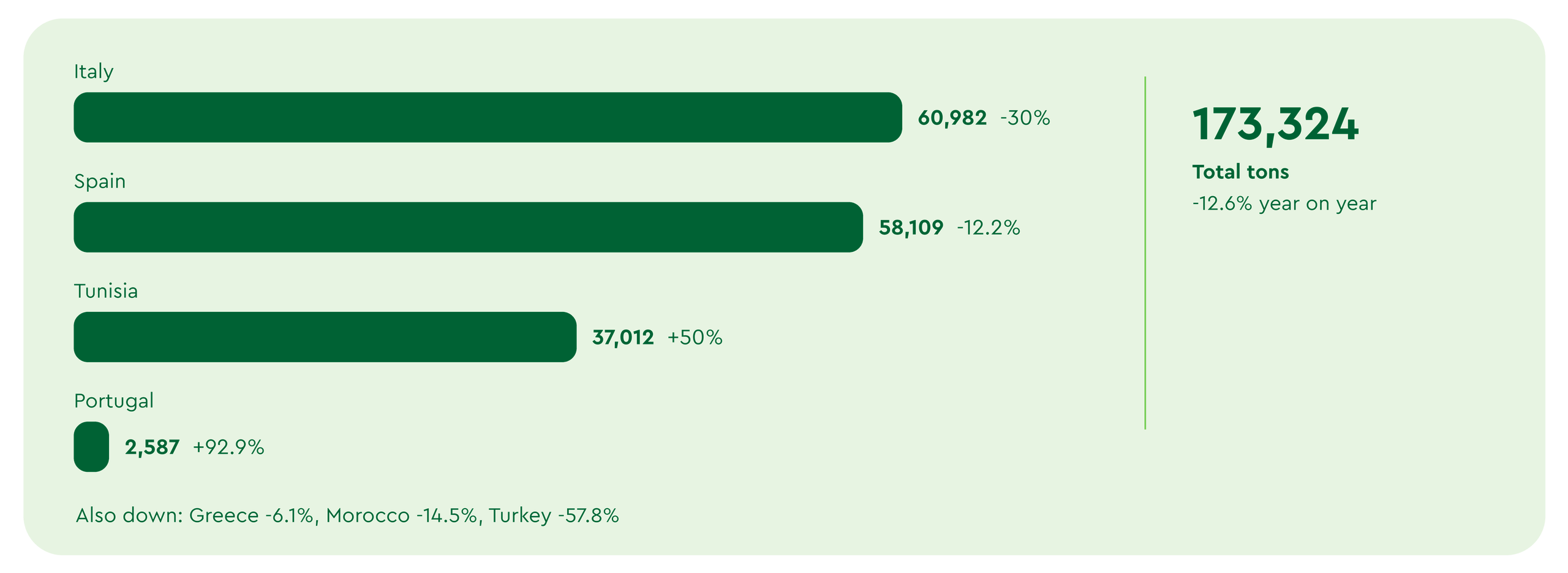
According to a recent article published by Olimerca in October, US imports of bottled olive oil declined by 12.6% year-on-year to approximately 173,324 tons between January and August 2026.
Italian-based companies remain the leading US trade partner, with shipments of 60,982 tons, despite a significant decline of 30%. Spanish exporters ranked second with 58,109 tons, down 12.2% compared with the same period in 2025.
In contrast, Tunisia expanded its market presence by boosting exports of packaged units to the US by 50% to roughly 37,012 tons. Portugal likewise saw dramatic growth, with US shipments surging 92.9% to approximately 2,587 tons, though its market share remains modest.
Other suppliers, including Greece, Morocco and Turkey, reported declines of 6.1%, 14.5% and 57.8%, respectively.
US Bottled Olive Oil Imports, January–August 2026 (tons)
According to the report, Tunisia’s competitive pricing is a key factor behind its growing market share. The article also highlights a shift in sourcing strategies among US bottlers, with at least one major player reportedly reducing purchases from Spain in favour of direct sourcing from Tunisian exporters to remain competitive in the retail market.
Looking ahead, Tunisia’s continued growth in the US market will depend not only on its price competitiveness but also on future trade policy developments.
Following recent determinations by the Office of the United States Trade Representative (USTR) under Section 301 regarding forced-labor import practices, US companies and brands importing olive oil from European Union origins (including Spain, Italy, and Greece) face a 10% tariff, while those importing products from other Mediterranean regions such as Turkey are subject to a 12.5% duty.
Tunisian olive oil remains excluded from these Section 301 measures, maintaining standard MFN tariff status. Meanwhile, a proposed restriction by the U.S. Federal Maritime Commission (FMC) on Spanish olive oil imports into the USA, stemming from a political dispute, could further impact the cost and accessibility of olive oil for North American retailers and consumers.
A separate article published by Olimerca in October highlights Tunisia’s growing importance in the US market beyond bottled olive oil. Between January and August 2026, total Tunisian olive oil exports to the US increased by 45.4% to 95,321 tons, surpassing Spain’s shipments of 90,556 tons, which declined by 22% year-on-year.
While the prospect of future trade policy adjustments cannot be entirely ruled out, this ongoing exemption provides Tunisian virgin and extra virgin olive oil with a distinct landed-cost advantage in the US market.
Final Thoughts on Strategic Procurement:
Olive growers across major Mediterranean producing countries are facing a profitability squeeze as lower producer prices collide with elevated operational costs.
Recent price data show year-on-year declines in Spain, Italy, Greece and Portugal, although the scale of the decline, and the economics of production, varies considerably between countries and growing systems of each specific geographical area.
The pressure extends beyond Spain. In Italy, falling prices and rising stocks of unsold oil are straining growers and processors. In Portugal, producers have reported higher labor, fertilizer, fuel and pesticide costs alongside lower prices for their olives, adding to the difficulties facing traditional groves.
In Italy, as well as in Spain, those pressures have prompted agricultural organizations and cooperatives to call for government intervention.
As reported by Olive Oil Times, Spanish operators are seeking the temporary withdrawal of surplus olive oil from the market under a mechanism that would allow up to 20% of estimated production to be held back, subject to specified market conditions. The aim is to ease oversupply and stabilize producer prices; the maximum withdrawal is not an agreed or automatic reduction.
The proposal remains contested. Spanish bottlers’ association Anierac and exporters’ association Asoliva argue that intervention is not sufficiently justified and have urged the government to assess the harvest before acting. Spain’s competition authority has also warned that withdrawing supply will most likely affect competition with other regions and raise consumer prices.
Meanwhile, a study by the Spanish Association of Olive-Growing Municipalities found that average olive oil production costs in Spain rose by nearly 57% between 2020 and 2026, with costs at traditional, non-mechanizable groves substantially exceeding prevailing market prices.
Together, these developments underline a wider challenge: a larger harvest does not necessarily mean healthier margins, particularly when producer prices fall faster than costs.
Final Thoughts: A Larger Harvest, Tighter Margins
Our teams are participating in the PLMA trade show in Chicago. Connect with us to schedule a meeting and build an effective Private Label strategy for 2027 and beyond.
Sources:
Poolred,
Ismea Mercati,
Junta de Andalucia,
Olive Oil Times
MAPA / AICA (Spain’s Ministry of Agriculture, Fisheries and Food)
The Spanish Association of Olive-Growing Municipalities
USTR (Office of the United States Trade Representative).

Share on


