The Long Chain: Cashews, Climate, and the Limits of Optimization
By Alison Smart — July 23, 2026
8 MIN READ
Our Quarterly Good Food Bulletin brings together company news, supply chain updates, and climate insights from our partners to help you navigate the evolving food and retail landscape.
Want it every quarter?
Sign up hereWhen you eat a cashew, you might not realize the complexity you are consuming. The growth and harvesting of the plant itself, and the subsequent supply chain that brings it to your plate, are remarkable. Both are intricate. Both depend on precise conditions. And both were built for a climate that is changing.
What the cashew, and its supply chain, need
The cashew is not technically a nut. It’s a seed that grows on the outside of a tropical fruit, encased in a shell containing a caustic liquid chemically similar to what makes poison ivy produce rashes on skin. After harvesting, cashews must go through an extensive process to become edible and ready for distribution, which is one of the reasons they command such a high price.
Throughout this long journey from germination to consumption, each step requires particular climate conditions: hot but not too hot, a pronounced wet season, and ample sunlight and dry conditions at other times. Rain is required for new vegetative growth, but the cashew tree also requires two to four months of dry conditions to trigger flowering and fruiting. During flowering, the plant needs temperatures between 24°C and 28°C, as prolonged heat above that threshold can damage the fruit. Dry conditions are essential during this phase and during harvest, unseasonable rain can ruin the nut at the moment it’s most vulnerable. And the wet conditions must return shortly after harvest to spur vegetative growth for the following season. Because of these interlocking requirements, cashews can only be harvested once a year.
Around 60% of the world’s raw cashews are grown in Africa, with West Africa accounting for over 45% of global supply. That tropical coastal climate delivered precisely what the crop needed, reliably, year after year. About 12,000km away in Vietnam, a well developed industry receives that raw product and processes it. According to Mai Phan, a supply chain expert at Certified Origins, the country processes more than 80% of the world’s traded cashew kernels. The US, Europe, and other end markets roast, flavor, and pack because they are closest to consumers.
That this remarkable food is available to people all over the world is a product of the stable climate humans enjoyed for roughly 12,000 years, a stability that allowed us to optimize supply chains with extraordinary precision. Each node was located where conditions were just right for that part of the process. Today, those conditions are changing.
West Africa: a challenge of timing
The long chain of cashew production often begins in Africa. Leading the world in exports is Côte d’Ivoire (or the Ivory Coast), where warm temperatures, consistent sunlight, and pronounced wet and dry seasons create ideal conditions for the cashew tree. Just as important as the conditions themselves is their timing. West Africa historically had reliable seasonal rhythms to which the cashew tree is deeply acclimated.
As the climate changes, that reliability is eroding in three ways:
Extreme heat. March 2026 brought exceptional temperatures to Ivory Coast just as the crop was reaching maturity, affecting nut size and in some cases causing fruit to drop prematurely. These conditions lasted around a month and were expected to affect the quality, volume, and price of one of the country’s most important agricultural exports — one that generates 15% of Ivory Coast’s agricultural export revenues and supports around 800,000 families. According to Financial Afrik, the heat stress affecting cashew orchards in the north of the country, the epicenter of production, arrived precisely as the 2026 cashew marketing campaign was opening, at a time when global prices were already under pressure.
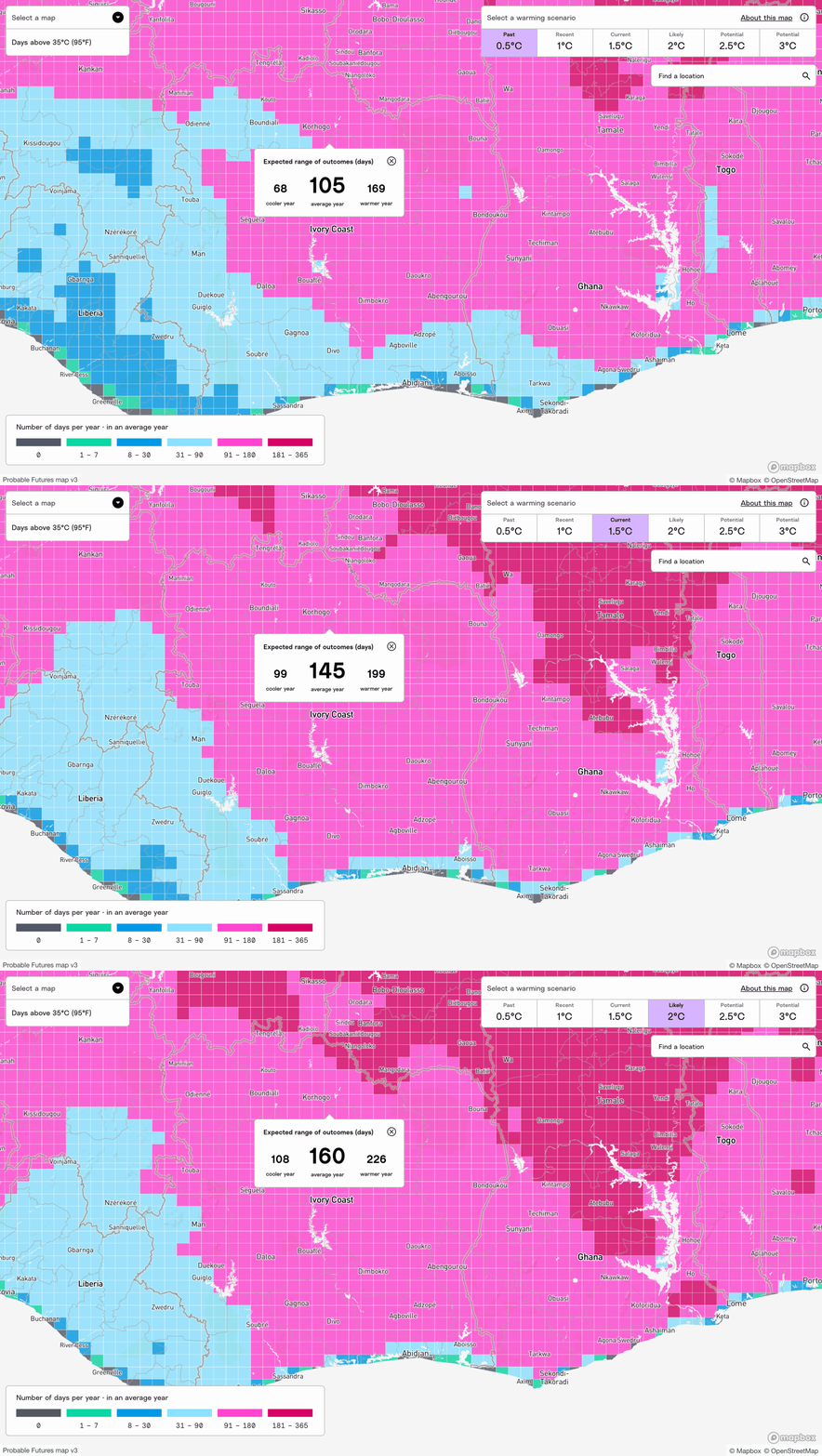
High temperatures at the wrong times. Probable Futures maps don’t show timing, but they do show the total number of days above a given threshold, and those numbers tell a story about when heat is likely to show up. In the north of Ivory Coast, the number of days above 35°C (95°F) in a past, stable climate averaged around 107, roughly three and a half months. At 1.5°C of warming, that rises to around 145 days in an average year, nearly five months, and as high as 199 days, or six and a half months, in a warmer year (such as an El Niño year). Those additional weeks of heat have to land somewhere on the calendar, and the most likely place is at the margins of the existing hot season, pushing into windows the trees aren’t built to handle. At 2°C, the average year is likely to see 160 days above that threshold, more than five months, with warmer years reaching 226 days, nearly seven and a half months. At that point, the question is how much room remains for the cooler, stable conditions the cashew tree evolved to depend on, and whether that window is still wide enough to sustain a harvest.
Unseasonable moisture (or lack thereof). Before cashews make their long journey to Vietnam, they must be dried to prevent rotting or molding during the month-plus voyage. This happens after harvesting, which is always during the dry season. Unseasonable rain, high humidity, and even persistently overcast skies can disrupt this process and compromise quality or ruin the crop entirely. Conversely, while drying requires sun and warmth, excessively high temperatures can cause the shells to dry too quickly, spoiling the kernels inside.
Phan works closely with farmers in source countries like Ivory Coast, and has a detailed view into how the moisture dynamics can affect the crop: “Farmers often mention that traditional seasonal patterns are becoming less reliable, making it harder to plan planting, flowering, and harvesting activities… Excessive rainfall during harvest can increase moisture levels, mold risk, and post-harvest losses, while drought conditions can reduce kernel size and overall productivity.”
From farm to factory and what happens in between
These farm-level climate challenges often travel with the product, showing up in different forms at the processing stage. Phan observes that quality inconsistencies from the source create cascading effects during processing: “Factories must adjust grading, sorting, and production planning more frequently, which can impact cashew recovery rates and processing efficiency. As a result, supply availability and quality can fluctuate more than in the past, making fruit volume forecasting increasingly difficult.”
While cashew processing in Vietnam relies heavily on automation and mechanized drying, unlike the sun-drying that happens in Africa, the changing climate is still making itself felt. Rising temperatures and extreme humidity in Southeast Asia are affecting when and how workers can operate and placing new demands on machinery.
The more significant story, though, is what happens to supply chains when their source becomes less reliable. Vietnamese processors have already begun diversifying their raw material sourcing across multiple regions to reduce exposure to weather-driven disruption at any single source. This is climate adaptation. It is also a signal that the extensive optimization that defined today’s cashew supply chain may not be the right model for tomorrow.
Climate literacy in action
From West Africa to Vietnam, the same underlying climate forces are at work, showing up differently at each node in the chain, but driven by the same dynamics. Climate literacy is becoming an essential skill for leaders at every phase of the cashew supply chain. It means being able to recognize these patterns wherever they appear: understanding not just that conditions are changing, but why they are changing, and what that means for systems that were built when they weren’t. Two concepts are particularly useful.
Warmer air holds more moisture. For every 1°C of warming, the atmosphere can hold roughly 7% more water vapor. This means both longer dry periods, because the atmosphere can hold moisture aloft longer before releasing it, and heavier rainfall when that moisture finally falls. The result is volatile swings between extreme precipitation and dry spells, or even drought.
Heat is energy. A warmer, more energetic atmosphere can exist in more states than a less energetic one. It can result in drought, storms, floods, hail, heat waves, and more. A warmer dry season or wet season is likely to be more volatile than it was in the past. For a crop like cashews, volatility is often more damaging than a directional change.
Phan notes that climate literacy and awareness is growing, but unevenly: “Large international retailers, food manufacturers, and sustainability-focused brands are increasingly interested in understanding climate-related risks within their supply chains. Buyers are beginning to ask questions about supply resilience, water management, regenerative agriculture, carbon footprint reduction, and long-term sourcing security. However, in the cashew industry, climate risk discussions are still less mature compared with sectors such as coffee, cocoa, or palm oil.”
The question for the cashew industry will be if climate literacy and climate adaptation can move as fast as the climate is changing.
The limits of optimization and the case for resilience
Climate stability was a precondition for the supply chain the cashew industry built. Reliable conditions at each location along the chain made it rational to be as complex and geographically dispersed as it became. Now, climate instability is testing the limits of optimization and forcing the industry to rethink it.
In West Africa, growers are experimenting with heat-tolerant varieties and improved soil management to retain moisture. More significantly, African countries like Ivory Coast are building their own processing capacity. This is both an economic move to capture more value locally, but also a resilience move to introduce processing in new geographies.
Vietnamese processors are making parallel moves. As Phan observes: “Many processors are diversifying raw material sourcing across Vietnam, Cambodia, and multiple African origins to reduce weather-related supply risks. Companies are also investing heavily in automation, quality control systems, and more efficient processing technologies to maintain consistent output despite fluctuations in raw material quality.”
What these responses share is a common logic. If conditions are likely to shift, single points of concentration carry risk, and geographic diversification is a form of preparation. In an unstable climate, optimization must make way for resilience.

Share on


