Why the future of food retail needs mission-driven brands
By Michael Ray Robinov
August 26, 2026
5 MIN READ
This article is featured in the Magazine “Private Label and National Brands: Decoding Food Retail”, created in collaboration with Global Retail Brands. You can find more insights about the Magazine and additional articles here.
Sign up here
For years, the food retail industry has been locked in a zero-sum debate: branded vs. private label. On one side, legacy consumer packaged goods (CPG) giants; on the other, private label offerings (often cheaper, but increasingly premium) backed by the muscle of big-box grocery chains.
But for all the market share this binary has captured, a third path is quietly emerging, one that doesn’t fit neatly into either camp, but is resonating more deeply with modern consumers: the path of the mission-driven brand.
From farmers markets to national direct-to-consumer (DTC) platforms, a growing number of mission-driven companies are reshaping food retail by putting transparency, ethics, and local sourcing at the core of their business models.
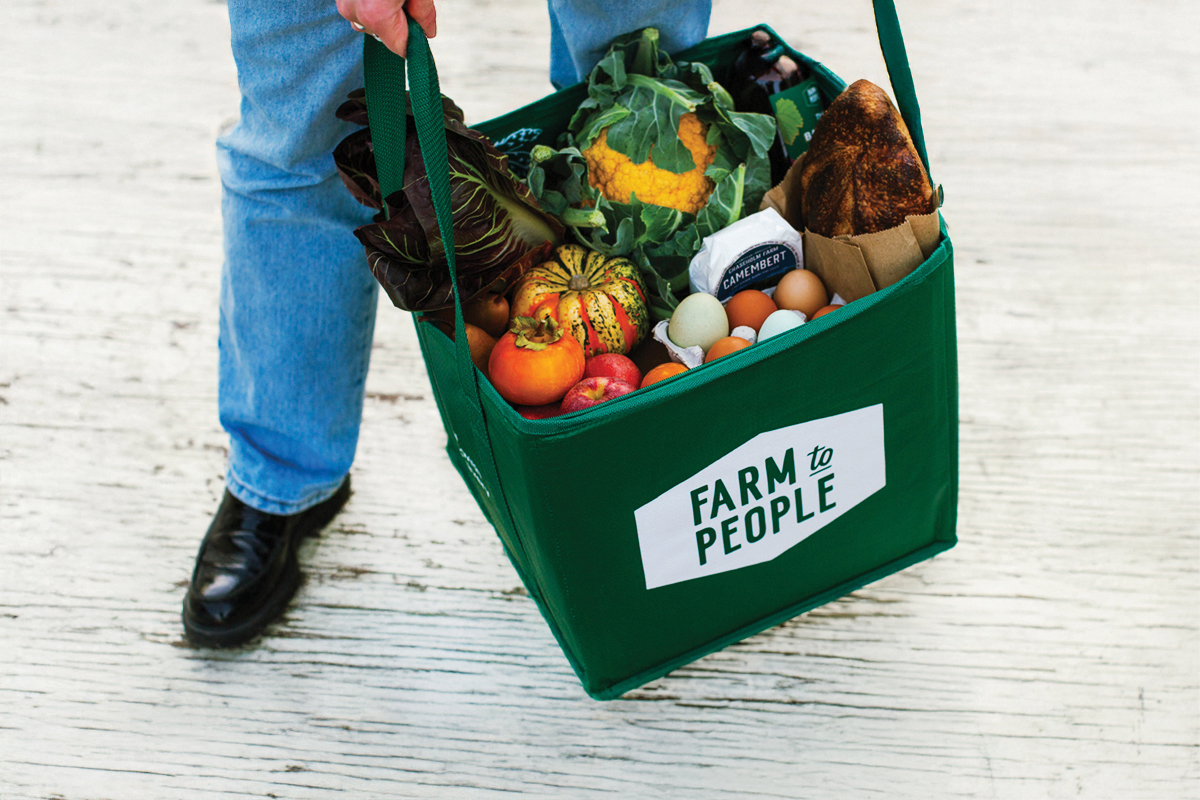
At Farm to People, we’ve been navigating this third path for over a decade. Operating in New York City, we deliver curated farm boxes, ethical groceries, and, more recently, our own kitchen-prepared foods, all sourced from a network of over 150 small farms and makers within 300 miles of the city. We’re not a traditional store, and we don’t carry many, if any, traditional brands. We’re one of many small companies redefining what “value” means to modern shoppers, not just in terms of cost, but in terms of connection, accountability, and impact.
This isn’t a niche phenomenon. According to NielsenIQ, 92% of consumers say sustainability influences their brand choice in fresh food, and products with sustainability attributes, like sourcing or packaging, are growing significantly faster than conventional options. It’s a structural shift in how food gets bought, sold, and valued.
Brands like Misfits Market, Big Spoon Roasters, and Thrive Market have tapped into this shift, combining purpose with transparency to drive not only growth but deep customer loyalty. Farm to People is part of this broader movement, where trust isn’t built with slogans but with sourcing decisions, supply chain clarity, and consistent communication.
In our own case, over 83.54% of active customers place repeat orders within 30 days, a metric that reflects more than convenience, it reflects a belief in the system we’ve built. In this way, mission-driven brands aren’t just competing on price or product, they’re competing on meaning, and they’re increasingly winning.
Beyond Price and Packaging
Consumers today have more access to food than ever, yet paradoxically, they’ve never felt less connected to it. We’re saturated with options, but few of them answer the questions that matter most: Where did this come from? Is it healthy for me? For our soil? Should I trust it?
Legacy brands lean on history. Private labels lean on price. But both often struggle to articulate where their food comes from or why it matters, especially as transparency becomes a top consumer expectation. Increasingly, they’re losing trust by adding artificial flavors, ultra-processed synthetics, hydrogenated oils, and more.
Mission-driven brands, on the other hand, earn trust through traceability and alignment with consumer values. People don’t just want to know their tomatoes are organic, they want to know the farm, the farmer, the story. They want to know that their money is supporting local economies and sending a larger share directly to the people growing their food, not just padding a balance sheet. In this way, mission-driven brands aren’t competing on cost or convenience alone. They’re competing on meaning. The retail world tends to underestimate how emotional food is. It’s not just sustenance. It’s identity, politics, and climate. When people shop with us or our peers, they’re not just buying kale, they’re voting for a different food system. That doesn’t show up in a P&L, but it shows up in retention.
Shorter Supply Chains Are Smarter, and Stronger
Mission-driven food brands often rely on shorter, more localized supply chains. That might sound idealistic, but it’s increasingly just good business. When COVID hit, the global food system cracked. Traditional supply chains saw massive disruptions, leaving shelves empty and logistics strained. Meanwhile, many small producers were stuck with unsold inventory.
Yet some local-first models, like farmers markets and regional community supported agriculture (CSA) programs, proved more resilient. With shorter supply chains and direct relationships, they could adapt quickly to shifting demand.
Mission-driven brands that operate in this space, including Farm to People, benefited from similar dynamics. Our supply chain was flexible, direct, and deeply human: built not on scale, but on trust. That trust becomes a strategic advantage. During the recent egg crisis, for example, when supply was tight, our producers stood with us, because we’d stood with them the season before.
Scale vs. Profitability
One of the common criticisms of mission-driven brands is that they don’t scale. But that assumes scale is the only thing that matters. I was recently inspired by Big Spoon Roasters’ decision to “break up with big grocery.” More and more, I hear that brands need to hit $20 million in annual revenue just to break even, not to mention the millions in capital required to get there. It’s no wonder that over 90% of small food brands go out of business within five years.
Yet, regional brands can thrive by choosing depth over breadth. A new playbook is emerging, one that values sustainable margins, slower growth, and direct community engagement over exponential scaling. Poppi, Siete, Simple Mills – these are success stories – but we need more models that embrace right-sized growth, not just explosive exits.
I yearn for a future that includes hundreds or thousands of profitable regional brands. Brands that don’t need to win every shelf. Brands that win hearts. Brands that show up in unexpected ways, through storytelling, education, hospitality. Brands that make food feel human again. I don’t want to live in a future where food is algorithmically optimized and shelf-stable.
I want to live in a future where someone cracks open their Farm to People box and is surprised by the flavor of an early-season strawberry from a Pennsylvania farm they now recognize by name. That moment may not be scalable, but it’s unforgettable. And unforgettable experiences are what drive retention in a market drowning in sameness.
Michael Ray Robinov is the CEO of Farm to People, where he sets vision and strategy for NYC’s premier farmers market grocery delivery service. Raised in the natural foods world and inspired by his first job at the Union Square Greenmarket, Michael co-founded Farm to People to connect folks (starting in NYC) with access to ethically grown food from local farmers and to foster a community around sustainability. His passion for sustainability, storytelling, and technology has helped bootstrap the brand into a leader in regional sourcing. He was selected to Forbes 30U30, Class of 2021.
1 NYU Sustainable Market Share Index™ 2021 Report
2 NielsenIQ “Green Divide” report (March/April 2025)

Share on


