Firming Prices, Projections, Supply Chain Transparency
6 MIN READ
By Franziska Finck — July 29, 2026
Our Monthly Olive Oil Market Report blends real-time data with field insights to
support your private label retail strategy.
Want it monthly?
Sign up hereWhat’s Happening This Month?
Market activity across primary Mediterranean origins entered a distinct consolidation phase throughout July as the 2025/26 campaign moved toward its final stretch.
While trading volumes remained relatively subdued and primarily focused on immediate industrial coverage, the overall market tone shifted from June’s tentative “wait-and-see” to active Q3 price stabilization.
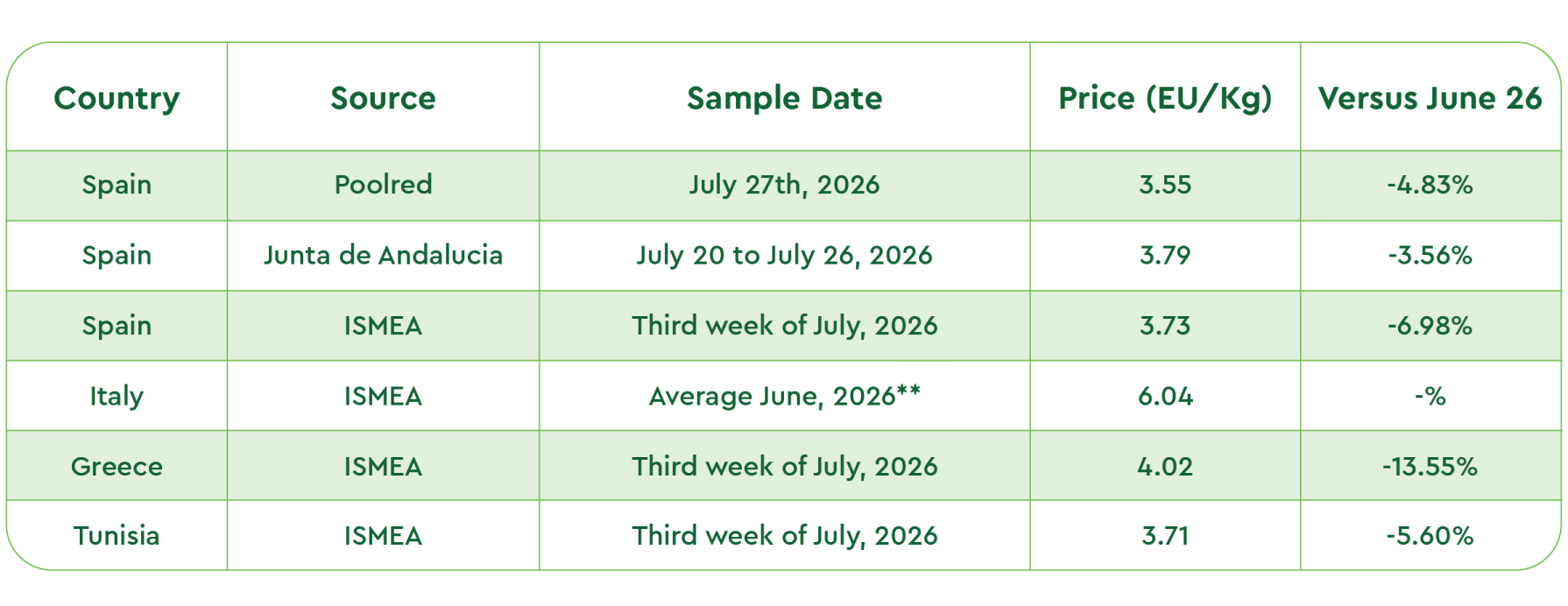
Following the price corrections observed late in Q2, origin quotations in Spain have firmed up. According to POOLred, Oleista, and regional market data, Extra Virgin Olive Oil averaged €3.43 – €3.52/kg at origin (with Jaén regional contracts holding at €3.39/kg and Andalusian regional averages reaching €3.85/kg according to the Junta de Andalucía).
Virgin Olive Oil averaged €3.25/kg, while Lampante maintained a solid floor at €3.00/kg – €3.05/kg. Buying interest for Virgin and Extra Virgin grades remains focused on immediate bottling needs, while refiners continue to provide steady support for Lampante.
Sellers are showing little willingness to accept further price reductions, encouraged by strong outflow numbers and growing concerns over mid-summer heatwaves.
Extra Virgin Olive Oil
Price Evolution 2022-2026
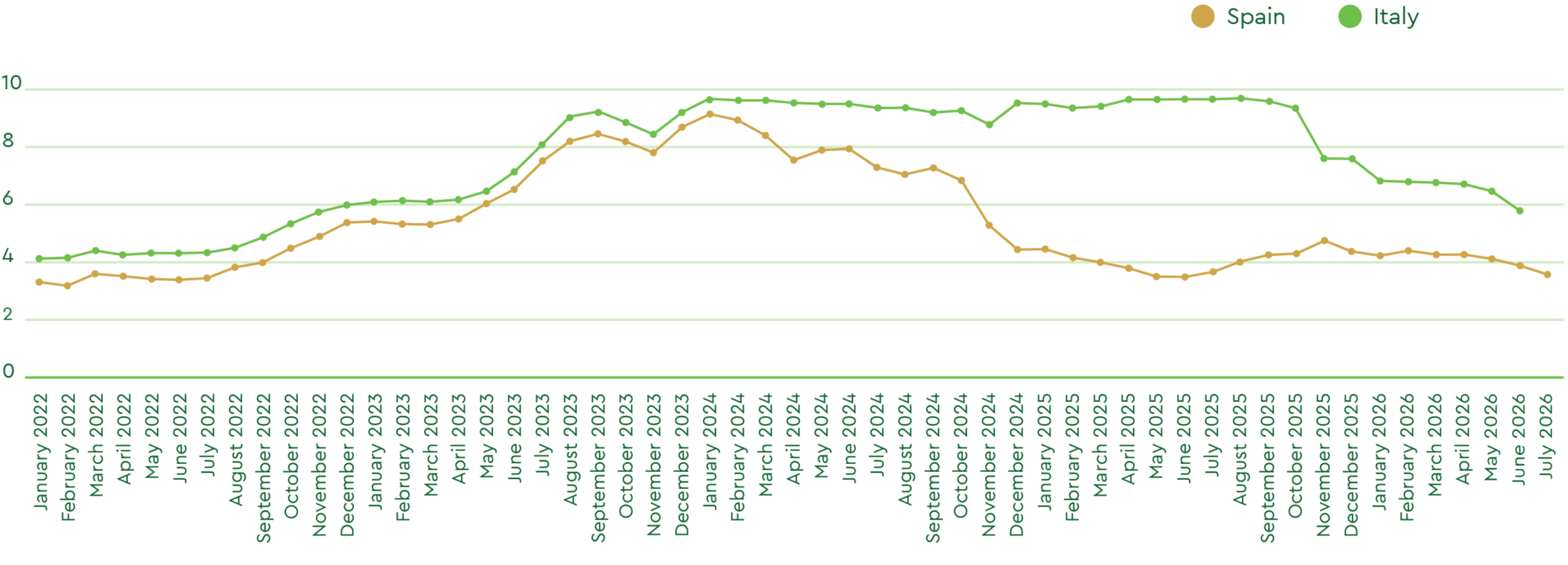
Note: Reported prices are averages across multiple quality grades. Premium, traceable, clean, pesticide-free extra virgin olive oil typically trades at higher values.
Sources: Poolred, Ismeamercati
Stock Situation in Spain and Italy in July
The latest market figures published by Olimerca confirm a strong demand environment in Spain across both domestic and export channels. Recent monthly outflows reached approximately 95,104 tons of olive oil (excluding imports), significantly exceeding traditional seasonal forecasts.

Total Spanish stocks stand at approximately 683,345 tons. Around 419,283 tons are held by mills (almazaras), 258,237 tons by bottlers and refiners, with the remaining volume (5,825 tons) stored by the Patrimonio Comunal Olivarero. Thanks to this sustained commercial performance, inventories are drawing down more rapidly than anticipated. Consequently, the projected carry-over stock (enlace de campaña) transitioning into the 2026/27 harvest is expected to fall to roughly 260,000 tons, a 10.4% drop compared to the previous campaign, easing carry-over pressure but tightening available supply as the new harvest approaches.
Italian cellar stocks
Olive oil in storage, year over year
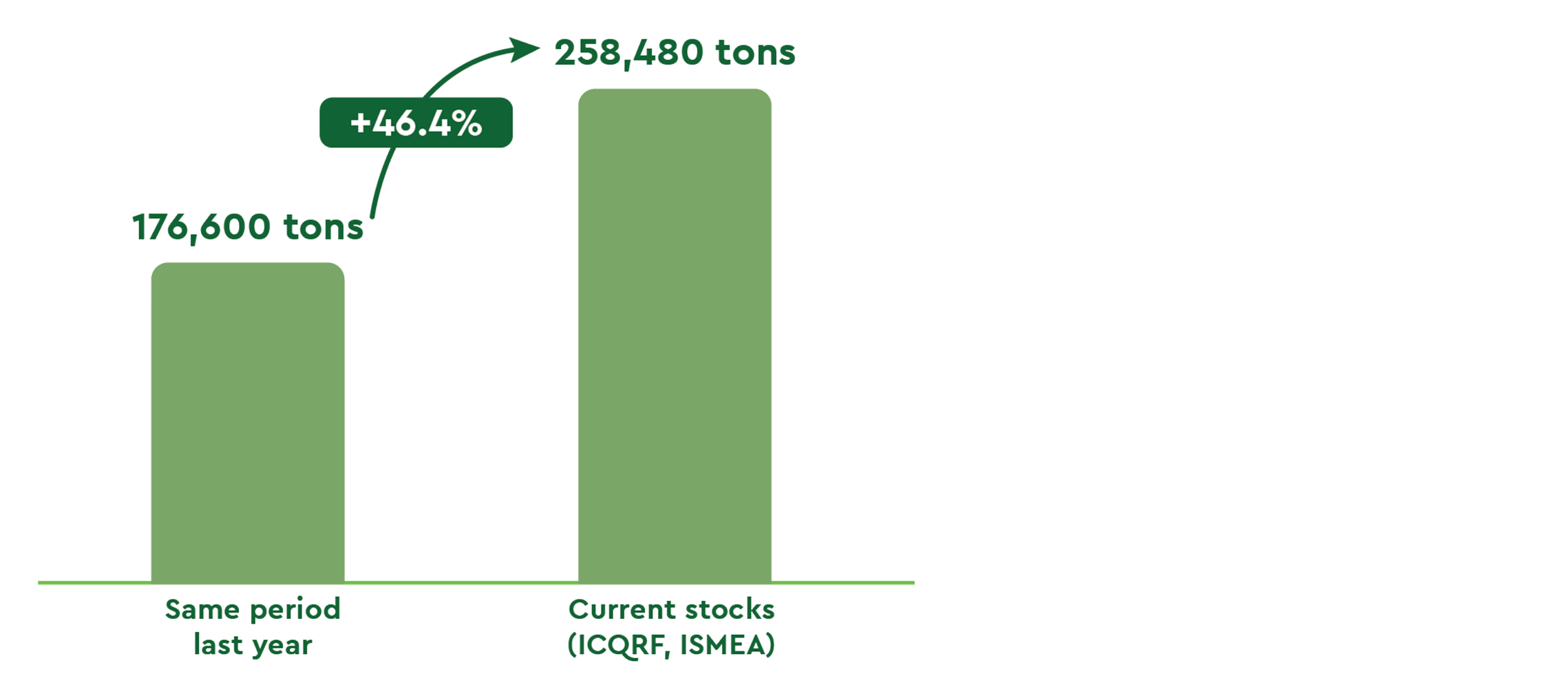
In Italy, figures from ICQRF and ISMEA Mercati show cellar stocks standing at approximately 258,480 tons, representing a 46.4% increase compared to the same period last year. This higher availability reflects the yield recovery of the 2025/26 Italian harvest. Despite larger stock holdings, market participants report steady demand for high-grade oil, supported by a +6% volume recovery in domestic retail supermarket sales during Q2 2026 (reaching 39.5 million liters according to the Sol Expo-Teatro Naturale Observatory).
Italy acts on EVOO regulatory frameworks and transparent labeling
Italy introduced clearer Extra Virgin Olive Oil labeling rules, directly impacting major domestic bottling hubs that produce and export many of the world’s top olive oil brands.
On July 16, 2026, Italy’s Ministry of Agriculture (MASAF) issued Circular No. 0347821, asking to enforce a strict component-level restriction in the Olive Oil sector.
Under this rule, blends containing lower-grade Virgin Olive Oil (VOO) as an input cannot be labeled as Extra Virgin Olive Oil (EVOO). Spain introduced a similar quality law, at the state level, in 2021 (Royal Decree 760/2021).
This MASAF directive seeks to implement the benchmark where any product packaged in Italy containing a portion of standard Virgin Olive Oil must be reclassified as Virgin, despite the outcome of sensory or chemical evaluations.
In contrast, regulations in several international markets allow a batch to be labeled as EVOO as long as the finished product passes physical, chemical, and taste tests, regardless of the input grades used in blending.
The directive has triggered an immediate legal debate. Sector analysts in Italy warn that an administrative circular cannot override broader statutory laws, opening the door to administrative court appeals and potential European Commission intervention.
These rules, while adding operational complexity for businesses operating out of Italy and Spain, provide a gold-standard model for global retail buyers and consumers seeking absolute quality and transparency.
Macroeconomic Impact: Extreme Heat, Rising Input Costs, and Global Logistics
Agronomic risks escalated significantly during July. Reports from Olimerca and APAG Extremadura highlight a severe heatwave that swept through southern Spain between July 5 and July 9, pushing temperatures in Andalusian growing regions to 42°C–44°C (107.6°F–111.2°F).
Extreme heat during early fruit development increases physiological stress on rain-fed olive groves, prompting agricultural bodies to advise caution regarding initial 2026/27 harvest forecasts.
On the financial front, farm input expenses – for specialized pesticides, fertilizers, tractor diesel, and industrial electricity – remain elevated across primary Mediterranean growing regions, increasing baseline farming costs by more than €200 per hectare.
To help offset fertilizer inflation, the European Commission announced a €540 million emergency aid package across member states, allocating €50.17 million to Spain from the EU agricultural reserve.
In trade policy, supply chain planners are closely monitoring international tariff negotiations. Following the launch of the new EU-US trade framework applying a flat 15% tariff ceiling on European goods, the European Commission continues talks seeking broader exemptions for European olive oil.
Meanwhile, North American buyers are watching the July 24 deadline for the US Section 122 global tariff (10%). Elevated maritime freight rates, fuel surcharges, and transit insurance continue to sustain a higher retail price floor in non-producing importing countries.
Final Thoughts on Strategic Procurement:
Despite a quiet spot trading at the origin, market fundamentals are tightening.
Strong monthly outflows have accelerated inventory reductions, bringing projected carry-over stocks down to approximately 260,000 tons, below last year’s transition levels. Following Q2 price adjustments, producers are standing firm, supported by low stock buffers and heatwave risks threatening the upcoming campaign.

Market attention is now focused on the transition to the 2026/27 harvest, conflict-driven costs, and US tariffs.
Prolonged heat or drought could further reduce crop expectations, while international trade tariff decisions and freight overhead will influence landed costs in overseas markets.
Global strategic procurement teams should view these concurrent shifts in weather patterns, origin pricing, trade corridors, and regional regulations as a clear signal to reassess traditional procurement models.
Future strategies must focus on proactive long-term planning rather than reacting to short-term spot-market volatility.
Reach out to the Private Label and sourcing specialists at Certified Origins to explore strategies for managing these shifting trade dynamics and ensuring the stability of your supply chain.
Sources:
OlivoNews,
Poolred,
Ismea Mercati,
Junta de Andalucia,
Teatro Naturale,
International Olive Oil Council

Share on


