Navigating the Final Months Before the New Crop
7 MIN READ
By Franziska Finck — Sept 30, 2026
Our Monthly Olive Oil Market Report blends real-time data with field insights to
support your private label retail strategy.
Want it monthly?
Sign up here
What’s Happening This Month?
Overall, September prices have remained broadly stable, with some weekly fluctuations but no significant further downward trend.
In the Spanish market, limited supply continues to underpin valuation levels, keeping standard-grade extra virgin olive oil near 3.50 to 3.90 Eu/Kg. Meanwhile, Italian conventional oil stands at roughly 4.70 Eu/Kg, with organic categories reaching approximately 5.30 Eu/Kg. Portuguese volumes are valued at around 3.80 Eu/Kg, while Tunisian-origin oil holds near 3.65 Eu/Kg.
These real-time price levels, identified by our sourcing team, mostly align with the main platforms offering general market benchmarks. Pesticide-free, PDO/PGI certified, and premium-grade extra virgin olive oils command significantly higher prices.
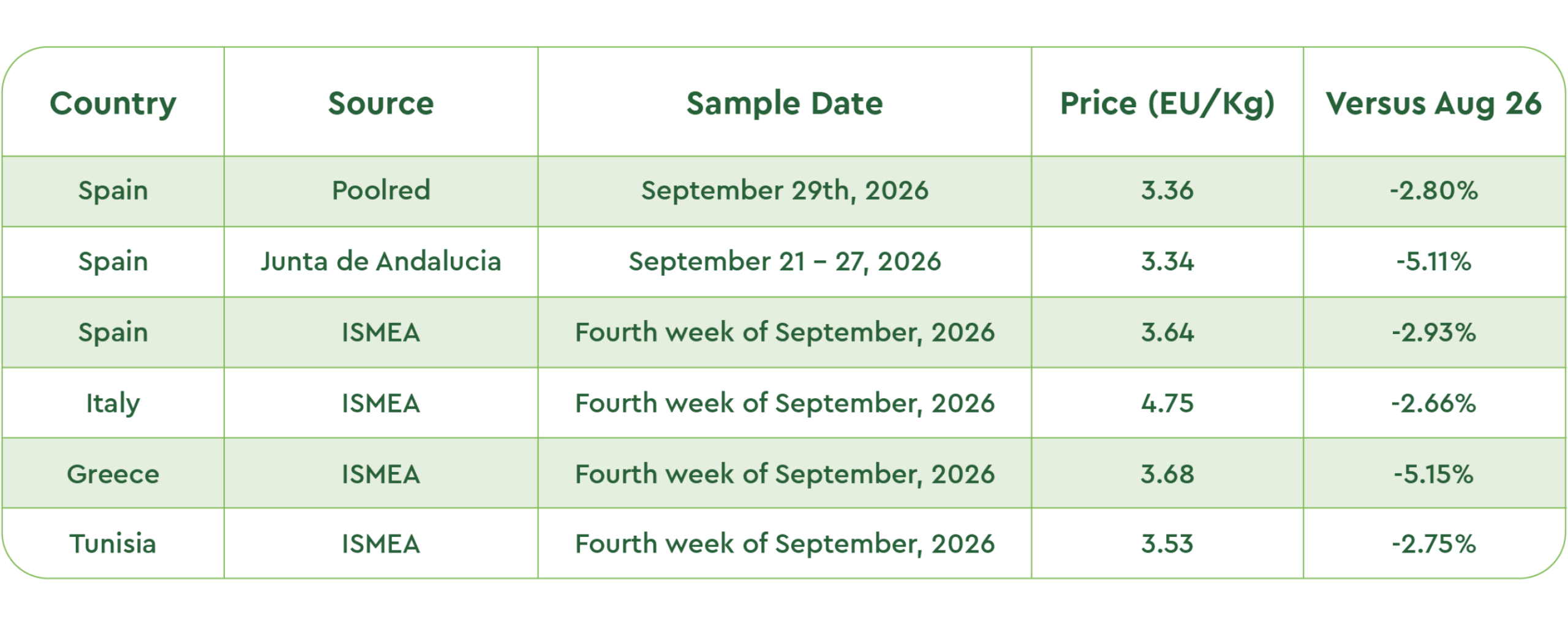
**Note: Reported prices are averages across multiple quality grades. Premium, traceable, clean, pesticide-free extra virgin olive oil typically trades at higher values.
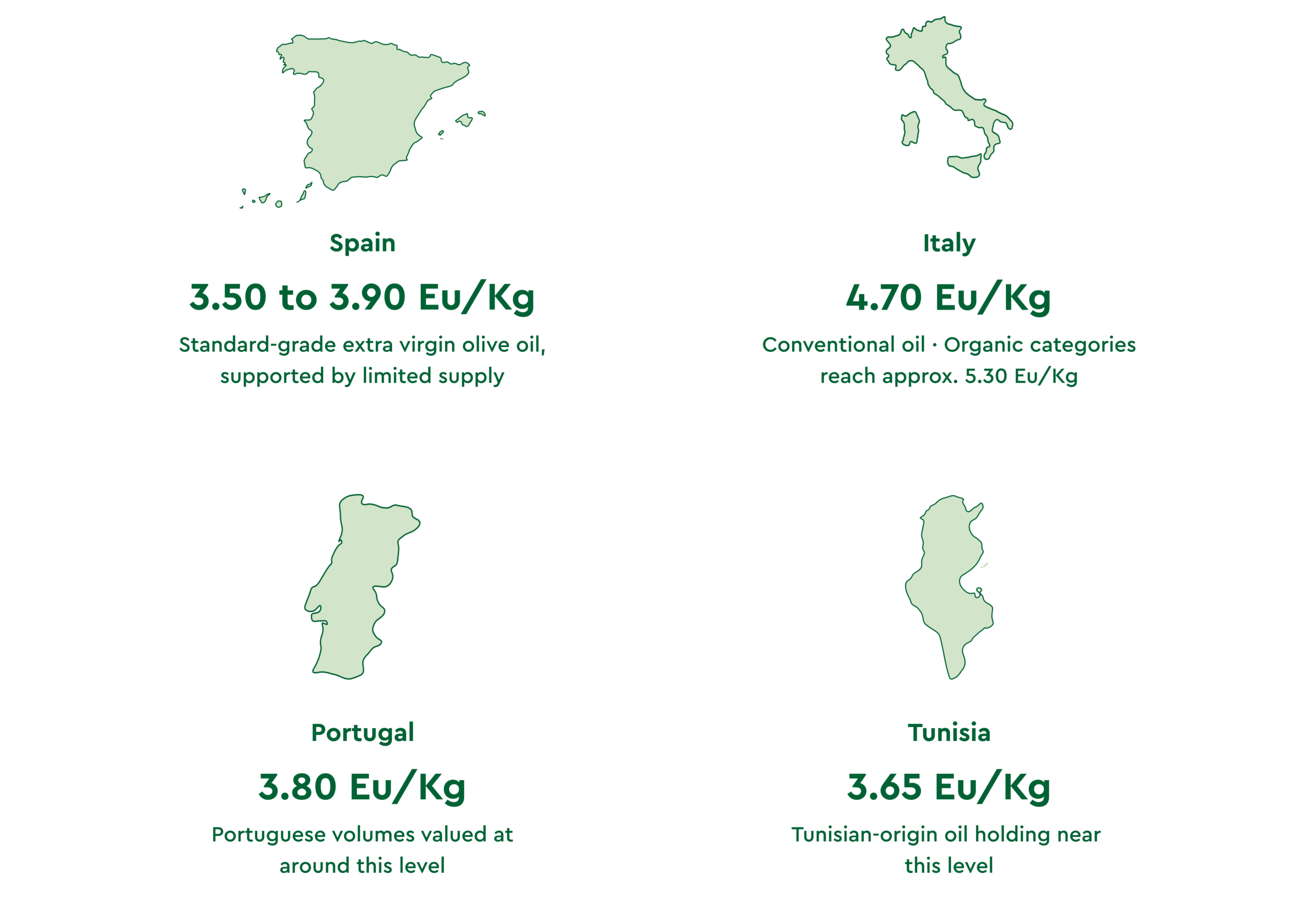 Sourcing Extra Virgin Olive Oil with strong organoleptic profiles is increasingly challenging at this stage of the season. As buyers proactively secure volumes ahead of the upcoming harvest, seller positions from European producers holding inventory remain firm.
In this context, early quotes for upcoming production from Tunisia and Morocco are beginning to weigh on market sentiment ahead of the campaign. Tunisian exporters are actively quoting for November delivery, intensifying competition as purchasers weigh these options against existing availability.
Market attention is increasingly focused on the start, progress, and early yield and quality insights from the new harvest.
Harvesting is beginning gradually across several producing regions, including Spain. A key milestone will be the official Andalusian harvest estimate, expected by the end of September, which should provide important guidance on the expected size and availability of the new crop.
Weather conditions remain an important risk factor. Continued dry conditions and high temperatures that characterized this past European summer, along with limited rainfall forecasts, are creating uncertainty about crop development and final yields. As a result, industry stakeholders are proceeding cautiously. Producers are closely tracking weather patterns and harvest progress, which are shaping pricing and business strategies.
Extra Virgin Olive Oil
Price Evolution 2022-2026
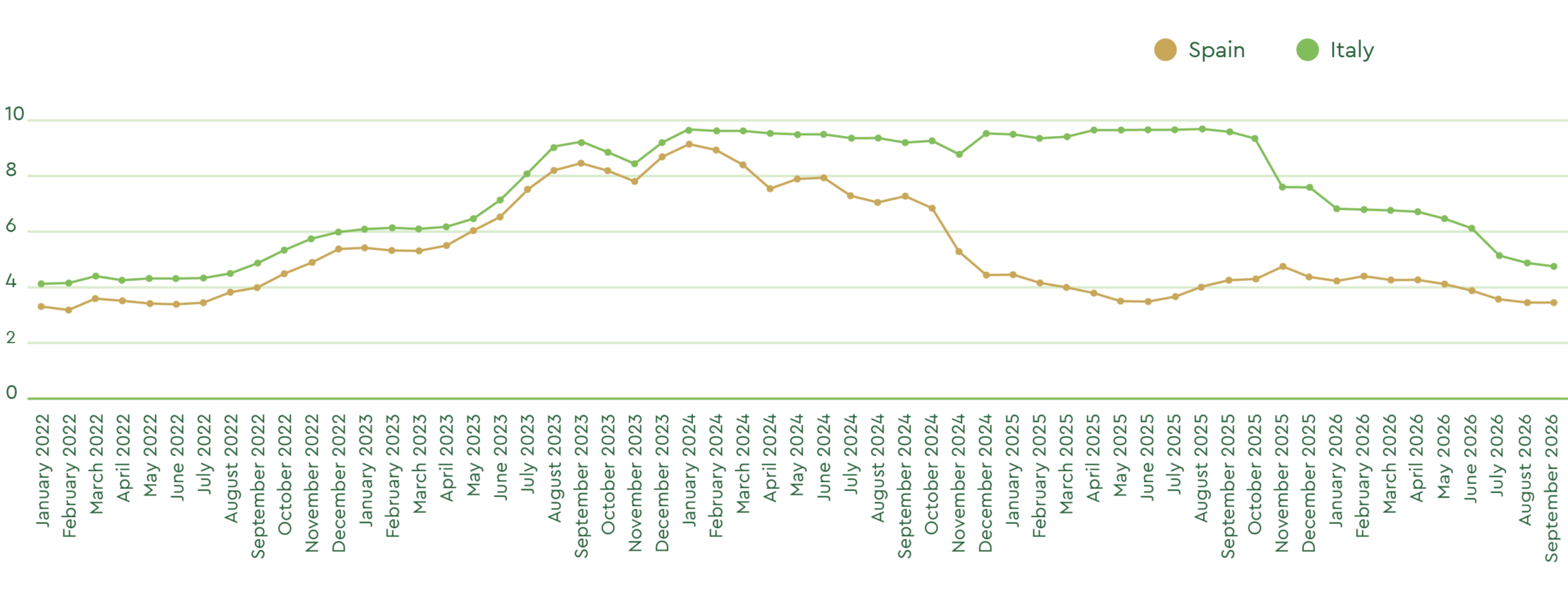
Sources: Poolred, Ismeamercati
Stock Situation in Spain by end of August
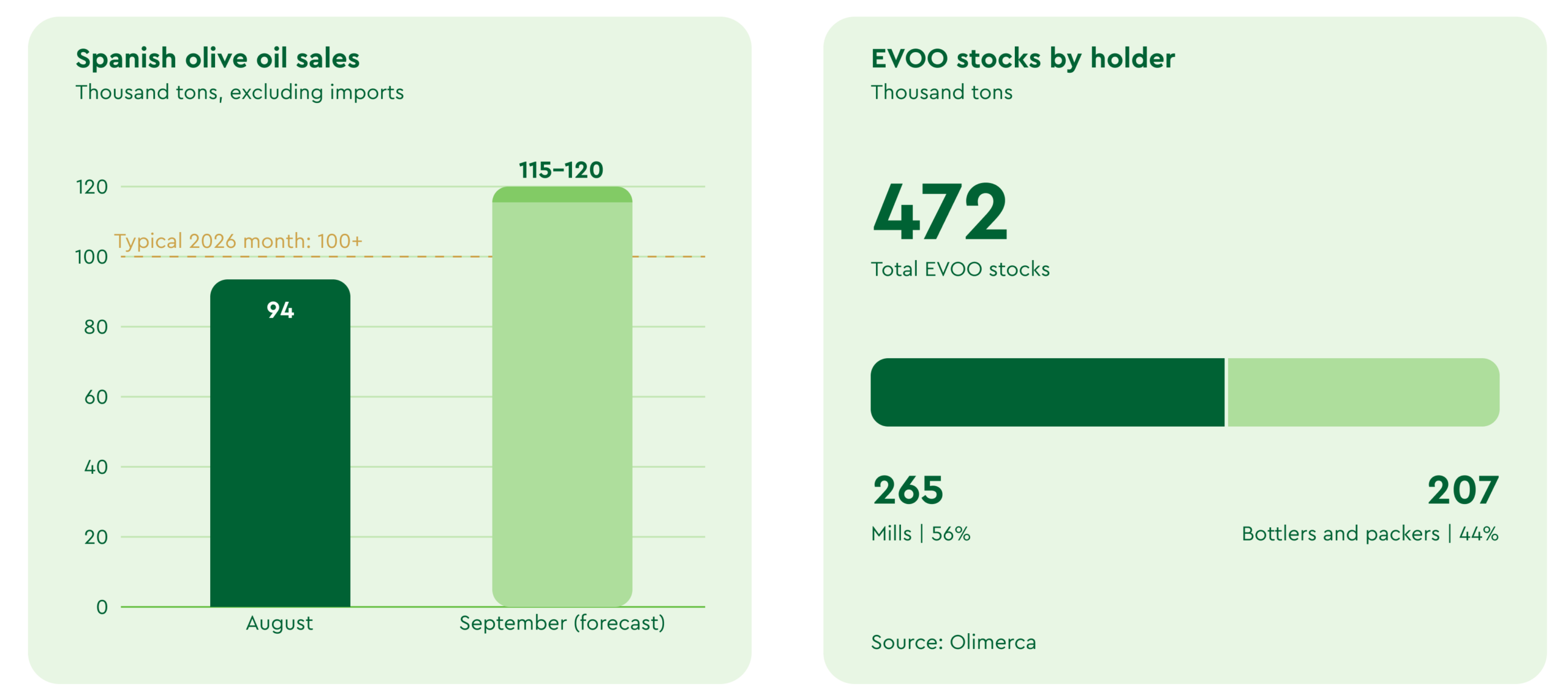
According to Olimerca, a Spanish trade publication specializing in the olive oil and olive sector, Spanish olive oil sales reached about 94,000 tons in August, excluding imports. While this is a relatively low monthly figure compared with levels in several other months of 2026, it is not particularly surprising, as August is traditionally a quieter month in Spain due to the holiday season and widespread business and mill closures.
For Extra Virgin Olive Oil, the market remains relatively well supplied, with total stocks exceeding 470,000 tons at the end of August. Approximately 265,000 tons were held by olive oil mills, while about 207,000 tons were held by bottlers and packers. Monthly market outflows in 2026 have generally been at or above 100,000 tons, underscoring strong demand despite the seasonal slowdown in August. September is expected to see a clear recovery, with sales estimated at 115,000–120,000 tons.
Italy’s Olive Oil Landscape and Investments
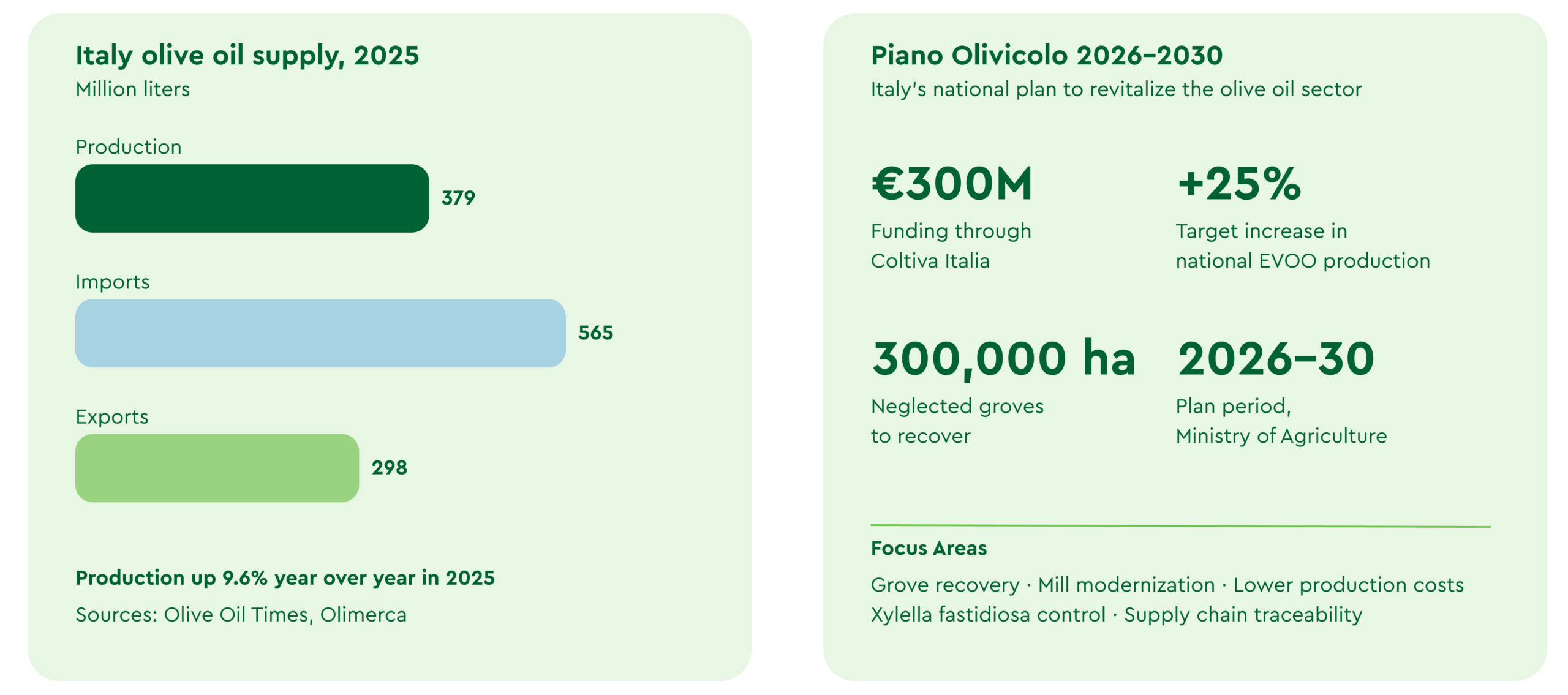
Data from Olive Oil Times and Olimerca indicate a marked decline in Italy’s domestic olive oil volumes over the past two decades. Energy and labor costs, lower yields, climate change, extreme heat and weather, pests, and the natural alternate-bearing cycle have all eroded Italian farmers’ operations and profitability. Although 2025 offered a temporary rebound, with production up 9.6% year over year, structural factors require a broader approach to support this key domestic industry.
A recent estimate suggests that about 300,000 hectares of olive orchards have gradually been neglected, especially in hilly and less accessible terrain, continuing to constrain Italy’s overall yield potential. The sector governing Italian olive oil operates along two distinct paths; each leverages the strong market appeal of Italian culinary heritage while facing its own challenges. Thousands of small-scale producers craft premium Italian extra virgin olive oil, often certified organic or holding PDO and PGI designations, and depend entirely on local crops. These artisans face ongoing pressure from rising agricultural expenses, lower-cost international competitors, soil degradation, and substantial hurdles when attempting to expand into global distribution channels.
At the same time, Italy is also the primary base for many leading global Extra Virgin Olive Oil brands. Most of these Italian-born labels are now owned by Spanish or multinational parent companies that maintain active sourcing and bottling hubs in the country. By establishing an operational base in Italy, global players can capitalize on Italy’s rich gastronomic heritage, access to specialized labor, robust Mediterranean trade routes, strict government-led quality and traceability checks, and the strong market appeal of the “Packed in Italy” credential.
In 2025, Italy produced about 379 million liters of olive oil, while imports totaled about 565 million liters. At the same time, Italy exported about 298 million liters. This contraction in domestic output creates widespread challenges across the Italian olive oil sector, deepening dependence on foreign imports and threatening the economic viability of small-scale growers who cannot compete with lower-cost producers.
Smaller farms and award-winning brands are among the pillars of the prestigious global reputation of Italian Extra Virgin Olive Oil, contributing to its market valuation and serving as living postcards for millions of international visitors who look for Italian names on a label when they return home for routine grocery shopping.
For these reasons, the Italian government has just approved the 2026–2030 Piano Olivicolo, a national strategic plan formally adopted by Italy’s Ministry of Agriculture to revitalize the country’s olive oil sector. Backed by approximately €300 million through the Coltiva Italia framework, the plan aims to increase national extra virgin olive oil production by 25%. The initiative focuses on recovering abandoned olive groves, modernizing olive mills, lowering production costs, combating Xylella fastidiosa, and strengthening supply-chain traceability to protect authentic Italian olive oil from fraud.
Global Olive Oil Trade Trends
Global olive oil trade dynamics show contrasting patterns throughout 2026. Although export shipments from European Union producers face ongoing political and market headwinds in traditional primary destinations, a new expansion trend continues in emerging export destinations, driven by bilateral trade agreements and private-sector initiatives.
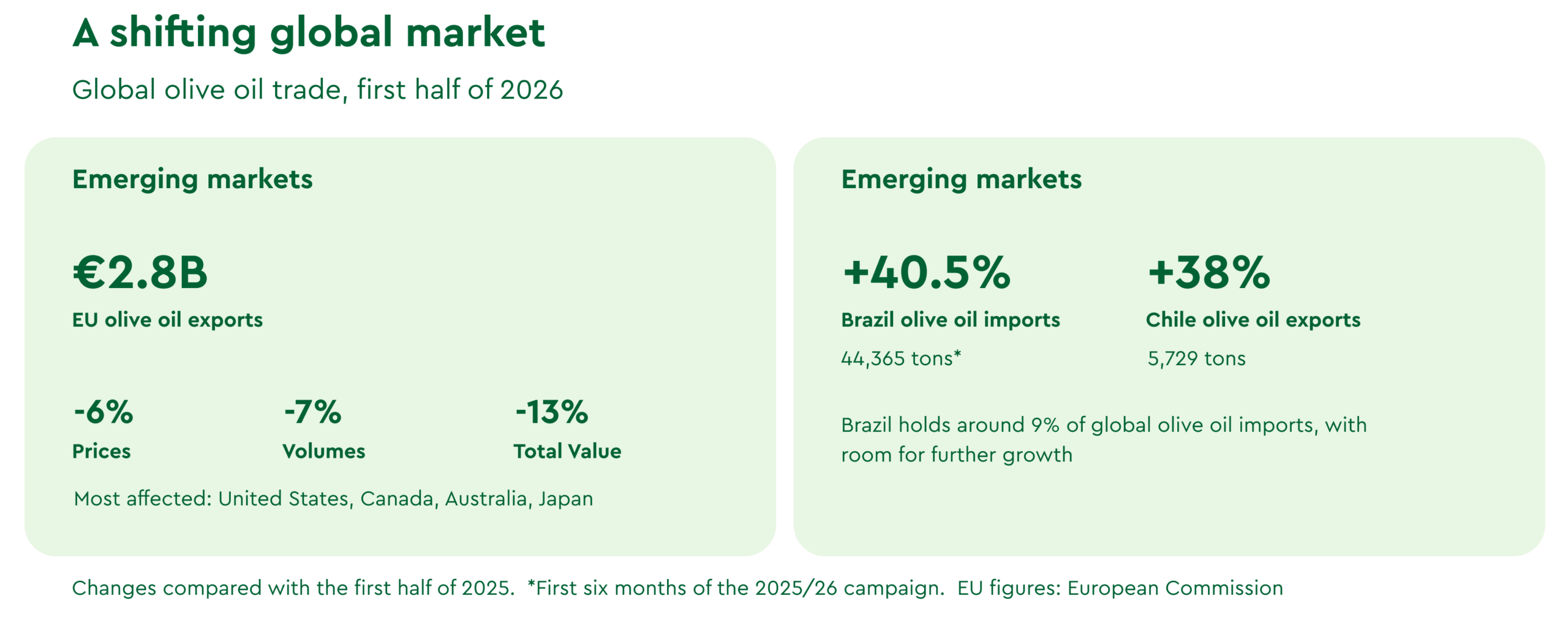
According to the European Commission, EU olive oil exports totaled about €2.8 billion in the first half of 2026, down 13% in value from the same period in 2025. The decline was driven by lower export prices (-6%) and lower volumes (-7%), with shipments to markets such as the United States, Canada, Australia, and Japan particularly affected.
Meanwhile, other parts of the global market are showing stronger momentum. Chile increased its olive oil exports by 38% in the first half of 2026 to 5,729 tons, while export value rose by 32%. Brazil was one of its most important destinations.
Brazil is also seeing strong demand growth, with olive oil imports up 40.5% to 44,365 tons during the first six months of the 2025/26 campaign. With around 9% of global olive oil imports and relatively low per-capita consumption, Brazil remains a market with further growth potential.
Other emerging markets are also showing positive developments. Egypt, India and Ukraine recorded increases in overall EU agri-food imports of 28%, 28% and 12%, respectively, although these figures do not specifically refer to olive oil.
Overall, the data point to a shifting international market equilibrium, with softening demand in established destinations and growing opportunities in select emerging markets. Strategic diversification across producers and brand markets is quickly becoming a priority for many olive oil exporters and sales teams.
Final Thoughts on Strategic Procurement
Heading into 2027, the olive oil industry faces severe pressure as production and logistics costs continue to rise, while market evaluations fail to pass these costs on to the shelf. Consumers, especially in middle- and lower-income groups, face increasing financial challenges.
A Spanish-based farming study shows that average olive oil production costs grew by ~57% over six years, now ranging from €3.08/kg for modern super-intensive groves to €5.31/kg for traditional steep-slope groves.
Rising energy, fertilizer, and transportation costs, compounded by climate risks such as drought and high temperatures, are further straining food producers and farmers. According to a recent analysis by the credit insurer Crédito y Caución, global food prices could increase by 11.6% in 2026 and by an additional 4.8% in 2027.
Looking ahead, market perspectives signal significant operational hurdles across the sector, shaped by elevated cost structures, ongoing valuation swings, and growing calls from farmers and industry players for targeted institutional backing, particularly within the European Union and the Mediterranean basin, which drives the vast majority of worldwide output.
Our teams are attending the SIAL event in Paris and participating in the PLMA trade show in Chicago. Connect with us to schedule a meeting and build an effective Private Label strategy for 2027 and beyond.
Sources:

Share on


